

 русский
 Deutsch
 عربى
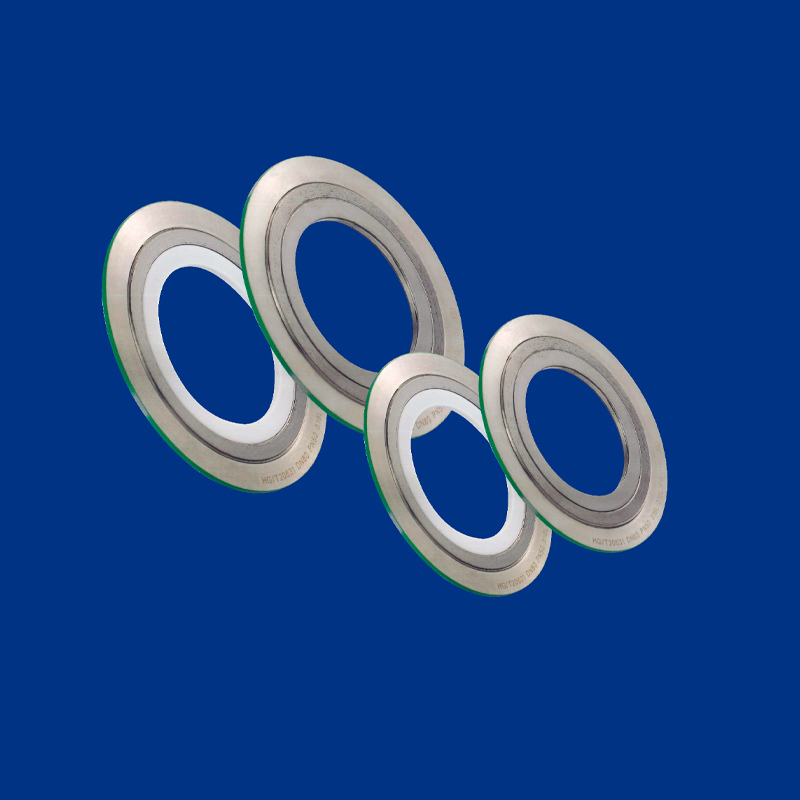



Gansu Juxiang Fluoroplastics Technology Co.,Ltd. is a fluoroplastic manufacturer based in Yumen City, Gansu Province, China, and builds the DSG Double Seal Gasket for flange joints carrying toxic, volatile, flammable or explosive media — ammonia, hydrogen sulfide, hydrogen — where a single sealing path leaves too little margin. The gasket pairs a spirally wound metal-band main sealing ring with a secondary sealing ring seated inside a toothed inner reinforcing ring, all held by an outer positioning ring. It is produced within a sealing range that also covers modified PTFE, expanded PTFE and large molded sealing frames.
How the Double Seal Construction Works
The DSG is a spiral wound gasket with a second sealing element built into the bore. The main sealing ring is formed by winding a metal band and a non-metallic filler strip together in a spiral: the band carries the compressive load while the filler deforms into the flange surface finish and closes the leak path.
- Outer reinforcing and positioning ring — locates the gasket on the bolt circle and limits compression so the winding is not crushed.
- Toothed inner reinforcing ring — a serrated ring at the bore that supports the secondary seal and resists inward buckling of the winding.
- Secondary sealing ring — non-metallic sealing material with a surface coating, seated inside the toothed ring as an independent barrier at the bore.
- Low pre-tension design — the joint seats at a lower bolt load than a conventional spiral wound gasket of the same size.
Because the two sealing paths sit at different diameters, medium passing the primary winding still meets the secondary ring before reaching atmosphere. Compression and recovery behaviour holds the joint stable through pressure, temperature and vibration cycling, and the structure targets the tightness levels demanded by VOC and VHAP emission control.
Service Envelope and Application Fit
Graphite winding covers the high-temperature end of the range; PTFE winding covers chemical and high-purity duty. The two are not interchangeable across the whole envelope — graphite needs a non-oxidizing environment, and PTFE is the correct selection where oxidising media or cleanliness rules graphite out.
| Parameter | Steel band + graphite | Steel band + PTFE |
|---|---|---|
| Temperature range | -196 °C to 650 °C, non-oxidizing service | -100 °C to 260 °C |
| Pressure class | Class 150 to Class 250 | Class 150 to Class 250 |
| Typical duty | Steam, hot process gas, hydrocarbons, heat-transfer fluids | Acids, alkalis, solvents, oxidising media, high-purity lines |
| Inner ring option | Toothed metal reinforcing ring | PTFE-encapsulated inner ring for food, pharmaceutical and electronics service |
| Emissions target | VOC / VHAP tight joint design | VOC / VHAP tight joint design |
Where the DSG Gasket Fits
Petroleum, chemical, metallurgical and power plants use the DSG on pipe flange interfaces, column and vessel nozzles, heat exchanger covers and valve bonnets — anywhere the medium is unforgiving of a leak path. Ammonia, hydrogen sulfide and hydrogen service is the core application, because those media combine low odour thresholds with real safety consequences.
With the PTFE-encapsulated inner ring, the same construction moves into clean service: food and beverage lines, pharmaceutical process equipment and electronics wet benches, where a graphite-bearing bore is not acceptable and extractables matter.
Configuration Options We Build To
- Filler grade — graphite or PTFE winding, selected against temperature, oxidising potential and cleanliness class.
- Band and ring alloy — matched to the flange material and the corrosion duty of the line, so the gasket does not become the weak point in a stainless or alloy system.
- Inner ring — plain toothed reinforcing ring, or PTFE-encapsulated secondary seal for hygienic and high-purity duty.
- Outer ring — centering ring with compression stop, or a plain outer ring where the flange facing itself controls compression.
- Dimensions — bore, outside diameter and thickness built to the flange standard and facing type of the line, including raised face, tongue-and-groove and male-and-female joints.
- Identification — size, class, filler and heat reference marked for plant stores and traceability.
The Sealing Range We Supply
The Double Seal Gasket manufacturer line sits inside a broader fluoroplastic sealing programme. The neighbouring families cover the cases where the DSG is not the right answer — lower pressure classes, large vessel openings, or fully non-metallic joints.
- Modified PTFE Gasket — fully non-metallic gaskets for chemical duty where metal contact in the joint is unwanted.
- Expanded PTFE Reinforced Flange Gasket — soft, conformable ePTFE with a reinforcement layer for irregular, worn or glass-lined flanges.
- Large integrated molded PTFE sealing frame and gasket — molded sealing frames for vessel and equipment openings beyond standard pipe sizes.
Information We Use to Configure Your Solution
A DSG configuration is only as good as the joint data behind it. These are the inputs that let us fix the winding, the rings and the dimensions without a second round of questions.
- Line size, flange standard and pressure class, with the facing type — raised face, tongue-and-groove or male-and-female.
- Media composition and concentration, including trace components such as hydrogen sulfide or ammonia.
- Operating and design temperature, plus any excursion, steam-out or regeneration condition.
- Operating pressure, and whether the joint sees thermal cycling, vibration or repeated bolt-up.
- Emission requirement — VOC, VHAP or a plant-specific leak target.
- Cleanliness class for food, pharmaceutical or electronics service.
- Flange and bolting material, so the band alloy and compression stop stay consistent with the joint.
- Quantity, delivery schedule and any drawing or sample the gasket must match.
Manufacturing, Documentation and Delivery Scope
Gansu Juxiang Fluoroplastics Technology Co.,Ltd. is a joint venture of Zhejiang Jiaxiang Fluoroplastics Co., Ltd. and Gansu Juhua New Materials Co., Ltd. (Juhua Group), established in September 2025 with registered capital of 30 million yuan and production bases in Zhejiang and Gansu. Our technical team works one-to-one on material matching, and production parameters are monitored in real time so a winding or molding deviation is caught before it reaches the finished part.
Custom manufacturing runs from drawings or physical samples, with material selection, mold optimization and process analysis handled before the first batch. Documentation and usage guidance are issued with the order, and inquiries are answered within 12 working hours. Delivery scope covers the finished gaskets, packing that protects the sealing faces and inner ring in transit, and marking of size, class and material on the pack.
Installation and Service Life
The DSG is a compression-sensitive component. It is fitted with new bolts, or verified reused bolts, lubricated to the specified friction factor and tightened in a cross pattern to the bolt load the flange class allows — the low pre-tension design reaches that load without over-stressing the flange.
Gaskets are single-use. Once compressed, the winding and the secondary ring take a set, and re-torquing a used gasket does not restore the original sealing margin. Spare stock is held flat, dry and free of load, and the bore and sealing faces are inspected before installation.
Frequently Asked Questions
What temperature range does the DSG double seal gasket cover?
With a steel band and graphite winding the range is -196 °C to 650 °C in non-oxidizing service. With a steel band and PTFE winding it is -100 °C to 260 °C. The filler is chosen from the actual medium and temperature, not from the widest figure in the table.
Which flange classes and facing types can you supply?
The standard DSG range is published for Class 150 to Class 250 service, with dimensions built to the flange standard and facing type of the line. Raised face, tongue-and-groove and male-and-female joints are all produced; the bore, outside diameter and thickness follow the drawing or the applicable flange standard supplied with the inquiry.
When should the PTFE-encapsulated inner ring be specified?
Where the bore must stay clean or graphite is unacceptable: food and beverage lines, pharmaceutical process equipment and electronics manufacturing. The encapsulated inner ring gives the secondary seal a non-contaminating surface while keeping the metal-band main sealing ring for pressure and temperature capability.
Can you manufacture to our drawing or a sample gasket?
Yes. Custom manufacturing from drawings or physical samples is our core service. Send the dimensions, flange standard, medium, temperature, pressure and quantity, and we return a configuration and quotation; inquiries are answered within 12 working hours.