

 русский
 Deutsch
 عربى
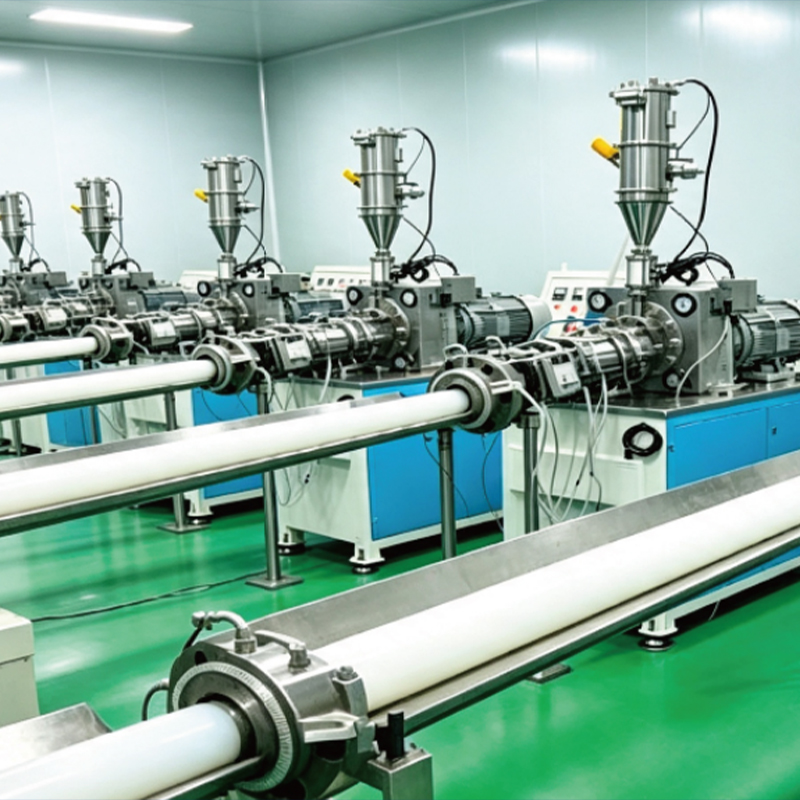



Gansu Juxiang Fluoroplastics Technology Co.,Ltd. is a fluoroplastic manufacturer based in Yumen City, Gansu Province, China, producing PTFE rod as machinable stock and as finished components for sealing, electrical insulation, corrosion-resistant and low-friction duties. Rod is made by three routes — paste extrusion for small diameters, ram extrusion across the mid range and compression molding for large sections — so one order can cover a Ø5 mm guide pin and a Ø400 mm backing ring from the same material family.
We run two production bases, in Zhejiang and Gansu, under a joint venture between Zhejiang Jiaxiang Fluoroplastics Co., Ltd. and Gansu Juhua New Materials Co., Ltd. of the Juhua Group. PTFE rod sits alongside our PFA, FEP, PCTFE, PEEK, PI and PVDF stock, which keeps one material specification and one inspection standard across a multi-polymer assembly. Customization to drawing or sample is our core service, and our international sales team handles export documentation directly.
PTFE Rod Range and Manufacturing Routes
Diameter decides the route, and the route decides the internal structure of the rod you machine from. Paste-extruded rod is dense and fine-grained for small sections; ram-extruded rod carries a degree of axial orientation through the mid range; molded billet gives the most uniform large cross-section for thick-wall parts.
| Route | Outside diameter | Standard supply form | Where it fits |
|---|---|---|---|
| Paste extrusion | 4–9 mm | Straight rod, 1000 mm | Small pins, thin insulators, laboratory and instrument parts |
| Ram extrusion | 4–200 mm | Straight rod, 1000 mm | Machined seals, bushings, valve seats, bearing sliders, guide elements |
| Compression molding | Above 200 mm | Large cylindrical billet | Large backing rings, sealing frames, thick-wall machined components |
Nominal lengths are 1000 mm, with length tolerance tightening as diameter grows. Rod above 200 mm is produced as molded cylinder stock and quoted against the finished part envelope rather than a nominal rod size, because the machining allowance and the blank geometry are set together.
Material Data and Working Limits
Virgin PTFE gives the combination most specifications are written around: chemical inertness across acids, bases and solvents, a low coefficient of friction without external lubrication, stable dielectric behaviour, anti-stick release and no ageing embrittlement in storage. The service window is wide and predictable.
| Property | Unit | Result |
|---|---|---|
| Apparent density | g/cm³ | 2.10–2.30 |
| Tensile strength (minimum) | MPa | ≥14.0 |
| Elongation at break (minimum) | % | ≥140 |
| Service temperature range | °C | −180 to +260 |
- Apparent density is the controlling bulk indicator for rod above 16 mm diameter; tensile and elongation are reported on the smaller sections where the test geometry applies.
- PTFE cold-flows under sustained load, so seal and bushing designs carry a defined compression limit and, where needed, a filled grade rather than virgin resin.
- Thermal expansion is high relative to metals; interference fits and bore clearances are set with the operating temperature in mind, not at 23 °C alone.
- Dielectric strength and low loss make unplasticised rod suitable for insulators, stand-offs and high-frequency hardware.
Application Fit by Duty
Most PTFE rod we ship is converted into a component that has to survive one dominant condition — chemical attack, sliding wear, electrical stress or thermal cycling. Matching the grade and the route to that condition is where the specification is won or lost.
- Chemical and petrochemical: rod machined into gaskets, valve seats, dip-tube components and tank-mouth seals where acid, alkali and solvent resistance is the primary requirement.
- Semiconductor and electronics: high-purity rod for wet-bench hardware, wafer-handling fixtures and insulating parts, where extractables and dimensional stability matter as much as dielectric performance.
- Automation and automotive: low-friction sliders, bushings and wear pads running dry against steel or aluminium, often paired with our PTFE piston rings and guide elements in the same assembly.
- Fluid power and sealing: rod stock for piston rings, guide rings, chevron packs and back-up rings, with filled grades used where pressure-velocity limits exceed what virgin PTFE will hold.
- Food, medical and laboratory: non-toxic, non-staining rod for fluid-handling fittings, jigs and instrument bodies.
Where the duty calls for higher compressive strength, better wear resistance or lower creep, we supply filled PTFE rod and tube with glass fibre, carbon, graphite, bronze or polymer fillers selected against the counterface and the media. For melt-processable parts, PFA rod and tube covers the same design intent with a different processing route.
Diameter Tolerances, Length and Acceptance
Rod is supplied to a plus-only diameter tolerance, which leaves the machine shop material to clean up on the outside diameter. The bands below are the standard published values; where two bands overlap, the applicable tolerance is fixed on the drawing at order confirmation.
| Nominal diameter (mm) | Diameter tolerance (mm) | Nominal length (mm) | Length tolerance (mm) |
|---|---|---|---|
| 4, 5, 6 | +0.48 / 0 | 1000 | +5.0 |
| 7, 8, 9 | +0.58 / 0 | 1000 | +5.0 |
| 10, 13, 15, 16, 18 | +1.10 / 0 | 1000 | +3.60 |
| 20, 25, 30 | +1.30 / 0 | 1000 | +3.60 |
| 35, 40, 45, 50 | +1.60 / 0 | 1000 | +2.50 |
| 55 to 100, 120 | +2.00 / 0 | 1000 | +2.50 |
| 110 to 200, 500 | +2.50 / 0 | 1000 | +2.50 |
| 170 to 400 | +3.0 / 0 | 1000 | +2.50 |
- Inspection covers apparent density on every batch and the tensile and elongation checks defined for the section size.
- Dimensional records are issued against the confirmed drawing, including diameter, length, straightness and surface condition.
- Colour, contamination and void checks are visual and dimensional; specific acceptance criteria are agreed in writing before production.
- Certification documents and batch traceability are supplied with the shipment documentation package.
Machining, Stress Relief and Installation
PTFE machines cleanly with sharp, high-rake tooling and light finishing cuts, but the material is soft and moves under clamping pressure. Rod is normally turned or milled slightly oversize and finished after stress relief where the part has a tight flatness or roundness call-out.
- Annealing between roughing and finishing reduces the risk of dimensional drift in parts with thin walls or tight tolerances.
- Support long, small-diameter rod along its length during turning; paste-extruded stock at 4–9 mm deflects easily.
- Use sharp cutters and avoid glazing — a polished, smeared surface hides subsurface voids and weakens sealed joints.
- Store rod horizontally, out of direct sunlight and away from heat sources, to limit bow before machining.
- For assembled seals, confirm the housing bore and gland dimensions against the finished part, not the nominal rod size.
Information We Use to Configure Your Solution
Our proposal is built from the working point, the media and the production target. The following inputs let us fix grade, route, diameter and inspection scope without a second round of questions.
- Finished part drawing or sample, with the machining allowance you expect us to leave.
- Rod diameter and length, or the blank envelope for molded cylinder stock.
- Service temperature range, continuous and peak, plus thermal cycling pattern.
- Media in contact, concentration and any cleaning or sterilisation regime.
- Pressure, sliding speed and counterface material for sealing and bearing parts.
- Grade preference: virgin PTFE, filled PTFE, modified PTFE or a melt-processable alternative.
- Annual quantity, call-off pattern and packing or pallet marking requirements.
- Inspection level, documentation language and any third-party witness point.
Send the drawing set with the application notes and our technical team returns a material recommendation, a route selection and a quotation. Enquiries are answered within 12 working hours, and customization to drawing or sample is handled as standard work rather than an exception.
Customer Questions
What diameter range do you produce in PTFE rod, and which route is used?
We produce from 4 mm to 9 mm outside diameter by paste extrusion, 4 mm to 200 mm by ram extrusion, and above 200 mm by compression molding, with large cylindrical billet available for thick-wall parts. Standard length is 1000 mm. The route is confirmed at quotation against your finished part geometry, because wall thickness and machining allowance can move a size from one route to another.
What material data accompanies a PTFE rod order?
Each batch is checked for apparent density in the 2.10–2.30 g/cm³ range, with tensile strength of at least 14.0 MPa and elongation at break of at least 140% reported on the sections where the test geometry applies. Dimensional records follow the confirmed drawing. Rod above 16 mm diameter is controlled on apparent density, which is the meaningful bulk indicator at that section size.
Can you supply filled or modified PTFE rod instead of virgin PTFE?
Yes. Glass fibre, carbon, graphite, bronze and polymer-filled grades are available in rod and tube form, selected against the counterface, the media and the pressure-velocity limit of the application. Modified PTFE grades are supplied where lower creep and improved weldability are needed. Tell us the duty and we will match the filler rather than defaulting to virgin resin.
Do you machine finished parts from rod, or supply rod only?
Both. Rod is supplied as cut stock for your own machining, and we also machine finished seals, bushings, insulators and fixtures to drawing or sample, including surface treatment and assembly where specified. As a PTFE Rod supplier in China we ship to more than 30 countries, with export packing and documentation handled by our own international sales team.