

 русский
 Deutsch
 عربى


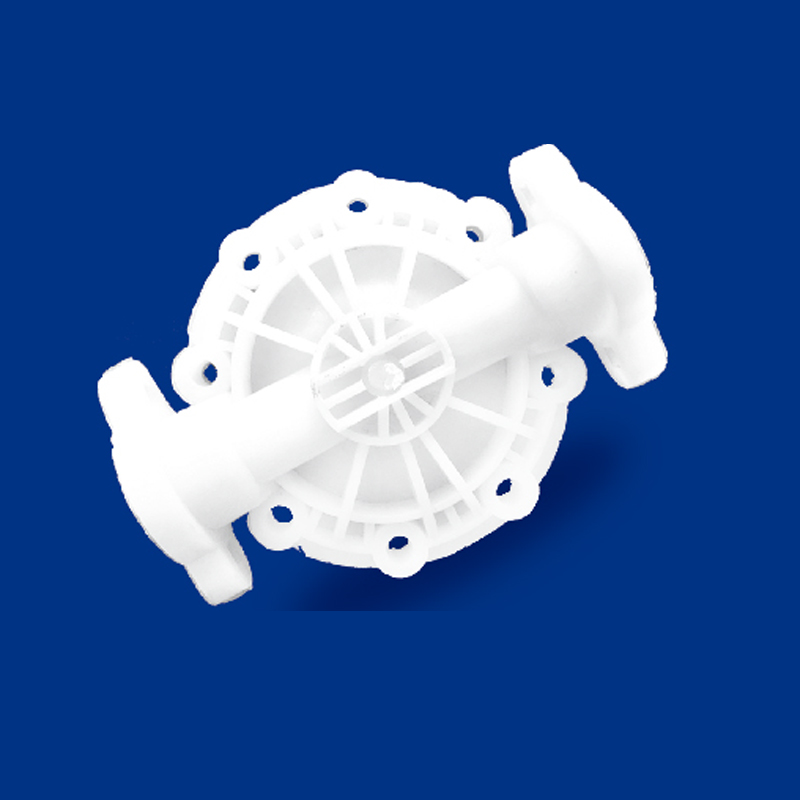
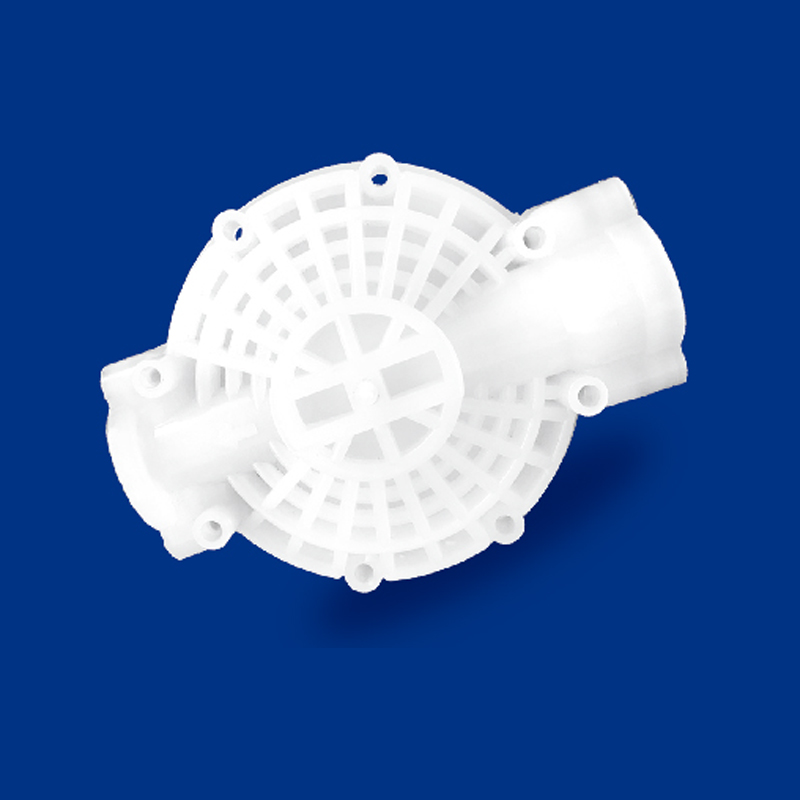



Gansu Juxiang Fluoroplastics Technology Co.,Ltd. molds PVDF components for chemical process equipment, water and effluent systems, semiconductor wet benches and outdoor electrical assemblies. We are a joint venture of Zhejiang Jiaxiang Fluoroplastics Co., Ltd. and Gansu Juhua New Materials Co., Ltd. of the Juhua Group, with production bases in Zhejiang and Gansu, China. As a PVDF Injection Molding Product manufacturer, we build to drawing or sample, from a single replacement impeller to scheduled production batches.
Where PVDF Molding Fits
PVDF sits between the fully fluorinated resins and the engineering plastics. It keeps the chemical resistance and UV stability of a fluoropolymer while carrying the stiffness, creep resistance and molded-in detail that pumps, valves and wet benches need. Our molding cell is set up for that middle ground: parts that must hold a bore, a flange face or a blade profile in continuous contact with acids, halogens, brine or high-purity water.
The range is centred on PVDF impellers and custom molded components, and extends to the pump and valve internals, pipe and manifold parts, column hardware and wet-process components that surround them. Because we also supply the machined and skived fluoroplastic families — PVDF Products, filled PTFE components and PEEK machined parts — a project that mixes molded and machined items can be quoted, inspected and shipped together.
| Component family | Where it fits | Grade direction | What we hold on the drawing |
|---|---|---|---|
| Impellers and pump hydraulics | Chemical transfer, scrubber circulation, brine and dosing pumps | Homopolymer, copolymer, carbon-filled | Blade profile from 3D model, hub bore and keyway, concentricity, dynamic balance, hydrostatic integrity |
| Valve bodies, discs, seats and liners | Diaphragm, ball and butterfly valves in acid and halogen service | Homopolymer, high-purity | Wall section, flange facing and bolt circle, seat geometry, pressure class, operating torque |
| Pipe fittings, manifold blocks and nozzles | Dosing skids, effluent lines, chemical distribution | Homopolymer, copolymer | Socket and spigot dimensions, thread form, port spacing, flatness, weldability |
| Column internals and tank hardware | Scrubbers, absorption towers, tank covers and weirs | Homopolymer, UV-stabilised | Formed geometry, flatness, rib layout, cut-and-drill features |
| Semiconductor wet-process parts | Tank internals, fluid delivery, wafer handling | High-purity PVDF | Extractables, surface condition, dimensional cleanliness, particle shedding |
| Custom housings, brackets and insulators | Outdoor and UV-exposed equipment, electrical assemblies | Homopolymer, flame-retardant grades | UV stability, dielectric strength, colour, dimensional and flatness limits |
Choosing the PVDF Grade
Grade selection changes both the molding window and the service life, so we settle it before tooling is released. The media list, the maximum continuous temperature, the cleaning regime and any purity requirement decide the polymer; the part geometry then decides cavity count, gate type and cooling layout.
| Grade | What it gives | Where it fits | Point to watch |
|---|---|---|---|
| Homopolymer | Highest stiffness and creep resistance, continuous service to roughly 150 °C | Pump and valve internals, impellers, structural parts in acid and halogen service | More notch-sensitive; needs generous radii and careful gate placement |
| Copolymer | Higher elongation and impact strength, wider molding window | Thick sections, low-temperature lines, fittings exposed to mechanical shock | Lower modulus and a slightly lower upper service temperature |
| Glass-fibre filled | Raised modulus, lower creep, tighter dimensional hold | Brackets, housings, pump bases, parts that must resist deflection | Reduced elongation; abrasive to tooling, screws and barrels |
| Carbon or conductive filled | Dissipative surface for solvent and powder handling | Carriers, flammable-solvent areas, ESD-sensitive assemblies | Colour and purity limits; conductivity verified on the molded part |
| High-purity / semiconductor | Low extractables and controlled metal-ion content | Wet benches, DI water manifolds, wafer-contact hardware | Dedicated handling and cleaning; confirmed against the customer specification |
Design and Tooling Rules We Work To
PVDF shrinks 2–3% and does so unevenly, which is why an impeller with a heavy hub and thin blades needs balanced core design rather than a packed blade root. We build the shrinkage allowance into the tool from the grade data and correct it on the first article, not on the production run.
- Wall sections held between roughly 2.5 mm and 6 mm with gradual transitions; ribs at 0.5–0.6 of nominal wall.
- Draft of 1–2° on vertical faces, generous fillets at blade roots and boss junctions, no sharp internal corners.
- Gate position set so weld lines fall away from hub bores, seal faces and high-stress blade roots; ring or central gating for impellers to keep fill balanced.
- Tooling in corrosion-resistant steel with nickel or chrome protection on cores and slides. PVDF releases hydrogen fluoride if it overheats, so shot size, residence time and barrel profile are set to keep the melt inside the grade window.
- Post-mold annealing for parts that must hold flatness or a bore fit through machining and service.
Critical Specifications and Acceptance
A PVDF part is judged on four things: does it fit, does it hold pressure, does it stay clean, and does it stay round. Each is written into the inspection plan at quotation rather than argued over at first article.
- Dimensional: tolerances on bore, hub face, flange facing, port centres and flatness, with a CMM report on the first article and agreed sampling thereafter.
- Hydraulic: hydrostatic proof at an agreed multiple of design pressure, with hold time and no weeping at weld lines or boss junctions.
- Balance: single-plane or two-plane balancing to an agreed grade for impellers above a stated diameter or running speed.
- Material: grade, batch, density and melt-flow certificate; filler content stated for filled grades.
- Purity: extractables and surface condition agreed against the customer specification for wet-process parts.
- Traceability: batch, cavity and molding date recorded against the delivery.
Information We Use to Configure Your Solution
A quotation that survives production starts from a small set of inputs. These are the ones that change the tool, the grade or the price, and having them at the start removes most of the back-and-forth.
- Geometry: 3D model and 2D drawing with tolerances, datums and critical features marked.
- Service: medium, concentration, continuous and peak temperature, and design pressure.
- Duty: continuous, cyclic or intermittent operation, expected life and replacement interval.
- Interface: mating shaft, flange standard, thread form, seal type and groove dimensions.
- Volume: annual quantity, batch size, and whether you need scheduled releases or a single run.
- Compliance: extractables, colour, food contact or flame-spread requirements.
- Logistics: marking, packaging, documentation and destination port.
- Existing parts: a sample, a worn component or a drawing of the mating part where the original drawing is unavailable.
Documentation, Packaging and Delivery
Every batch leaves with a documentation pack: material certificate, dimensional and inspection records, and handling guidance for installation and start-up. First articles are shipped with the full report so the part can be approved before volume begins.
Molding is scheduled across our Zhejiang and Gansu bases, which gives us a second production slot when a line is down and a replacement impeller is the critical path. Parts are bagged individually, cavity-marked and packed in foam-lined crates sized for the component; tooling is retained for repeat runs so a reorder reproduces the same cavity and the same inspection plan.
Frequently Asked Questions
Can you produce a PVDF impeller to replace one that has failed in service?
Yes. We work from the failed part, a spare, a 3D scan or the original drawing, rebuild the blade geometry and confirm bore, keyway and hub face against the mating shaft before the tool is cut. Balance grade and hydrostatic test conditions are agreed at quotation.
Which media rule PVDF out?
Strong bases, amines, ketones, esters and some concentrated alkalis attack PVDF. For those duties we propose PTFE, PFA or a filled PTFE grade instead. Send the media list with concentration and temperature and we confirm the polymer before any tooling decision is made.
How do you keep a molded PVDF part dimensionally stable during machining?
We anneal after molding, stress-relieve the blank and define the machining sequence before the first cut. For tight bore fits we mold oversize and finish machine after annealing, with the tolerance stack agreed between the molded and machined features.
What documentation accompanies a production batch?
Material certificate with grade and batch, dimensional report for the first article and agreed sampling, hydrostatic and balance records where specified, cavity and date marking on the part, and installation guidance. Documentation can be issued in the format your quality system requires.