

 русский
 Deutsch
 عربى
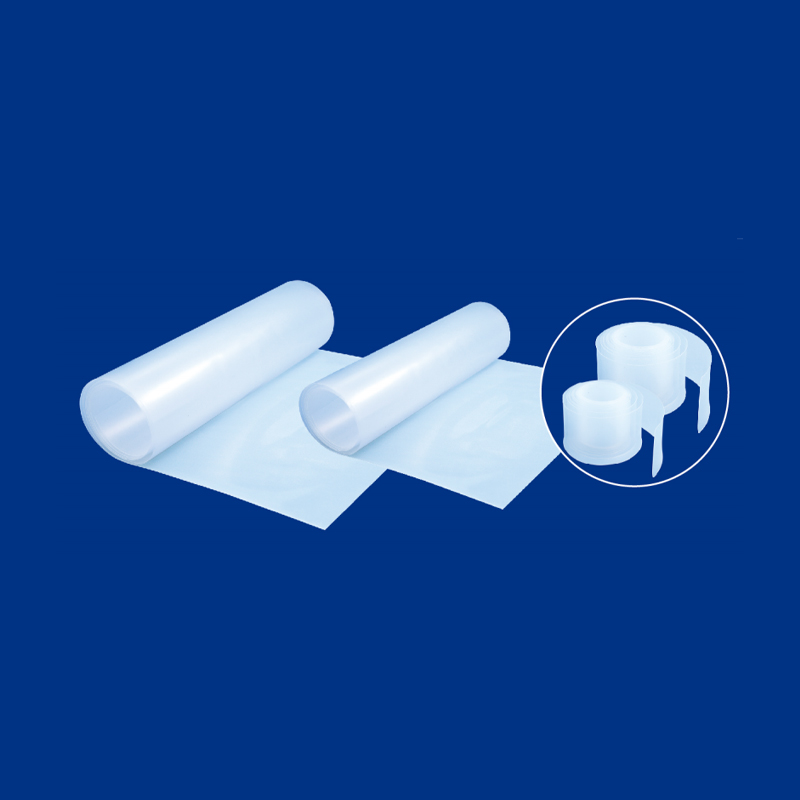



Juxiang is a FEP & PFA Film manufacturer supplying melt-processable fluoropolymer film to equipment builders, chemical plants, cable processors and fluoroplastic distributors. Film runs in lay-flat widths of 200–350 mm and thicknesses from 0.015 mm to 0.20 mm at our Zhejiang and Gansu production bases, inside the same supply chain as our PFA and FEP extrusion tube, PTFE skived film and machined sealing components.
Both polymers are fully fluorinated and both melt, which is the practical difference from PTFE film: FEP and PFA can be heat sealed, welded, thermoformed and laminated instead of only wrapped or clamped. FEP serves −200 °C to +200 °C; PFA raises the ceiling to +260 °C and retains more of its strength when an assembly is thermally cycled. The non-stick surface, dielectric behaviour and chemical resistance are effectively the same across the two grades.
Range and Material Positioning
We supply film as roll goods in defined thickness bands and confirm the grade — FEP or PFA — against the working temperature and the way the film is joined inside your assembly. Where a project sits close to a temperature limit, the grade decision is made on the peak condition rather than the nominal one.
| Property | FEP film | PFA film |
|---|---|---|
| Service temperature | −200 °C to +200 °C | −200 °C to +260 °C |
| Melt processing | Heat sealable, weldable, thermoformable | Heat sealable, weldable, thermoformable |
| Anti-stick contact angle | θ = 114° | θ = 114° |
| Dielectric constant, 60 Hz–60 MHz | 2.1 | 2.1 |
| Volume / surface resistance | >10^18 Ω / >10^13 Ω | >10^18 Ω / >10^13 Ω |
| Arc resistance | >165 s | >165 s |
| Coefficient of friction | 0.2–0.3 | 0.2–0.3 |
| Combustion in air | No flame; oxygen index >95 Vol% | No flame; oxygen index >95 Vol% |
| Chemical resistance | All chemicals except elemental fluorine and alkali metals at high temperature | All chemicals except elemental fluorine and alkali metals at high temperature |
| Typical film role | Release, cable wrap, heat-seal layer, duct lining | Higher-temperature release, wet-process barriers, hot laminating |
Thickness, Width and Roll Formats
Film is produced as lay-flat stock and supplied on cores, with slit width, roll length, core diameter and wind direction agreed per order so the roll can go onto a sealing or laminating line without re-winding. The standard bands are:
| Lay-flat width (mm) | Thickness (mm) |
|---|---|
| 200–250 | 0.015–0.02 |
| 250–280 | 0.03–0.04 |
| 250–300 | 0.05–0.15 |
| 300–350 | 0.15–0.20 |
Widths and thicknesses outside these bands are reviewed against the application before we quote. Thickness tolerance, the measuring points used to verify it and the edge condition are written into the order specification, because a film that is acceptable for a release application and one destined for a dielectric barrier are not inspected to the same limits.
Application Fit Across Process Industries
- Semiconductor and wet-process equipment — tank and duct lining, splash shielding, carrier surfaces and high-purity barriers where PFA's 260 °C ceiling and smooth inert surface justify the higher grade.
- Chemical, petrochemical and power — release shims under flange gaskets, barrier liners for sumps and vessels, protective facing for sight glasses and instrument windows exposed to acid or solvent splash.
- Wire, cable and electrical — wrap insulation on conductors and busbars, coil and magnet wire wrap and slot liners, using the 2.1 dielectric constant and >165 s arc resistance.
- Composites, laminating and hot-melt processing — release film in press lamination, carrier web for hot-melt adhesive and vacuum-bag release where a non-stick surface must survive repeated press cycles.
- Automotive, aerospace and general machinery — anti-chafe and low-friction shim stock, harness wrap and sliding surfaces that must stay clean without lubrication.
- Medical, pharmaceutical and food handling — inert, non-stick heat-seal and conveyor surfaces that are cleaned between batches.
Where a joint does not need to be sealed or welded and the widest chemical and thermal envelope is the priority, PTFE Film remains the alternative. FEP and PFA are specified when the film has to become part of a sealed, welded or laminated assembly, and they are frequently ordered together with FEP, PFA Extrusion Tube for lining and sleeving in the same equipment. For structural builds, PFA Backed Glass Fiber Sheet carries the same resin system in a rigid laminate.
Specifications We Fix Before a Roll Is Made
- Nominal thickness, tolerance band and the number of measuring points across the web.
- Lay-flat width, slit width tolerance and edge condition — clean slit or trimmed.
- Roll length, roll diameter limit, core material and core internal diameter.
- Surface condition: untreated, corona treated or chemically etched for adhesive bonding.
- Optical requirements — clarity, colour and freedom from visible gels, pinholes and carbon specks.
- Mechanical targets such as tensile strength and elongation at break where the film is thermoformed or drawn.
- Heat-seal strength and sealing window when the customer seals the film in-house.
- Splice policy, roll identification and the documentation to be issued with each lot.
Converting, Sealing and Line Integration
Because the film melts, it can be joined to itself, to PFA tube and rod, and to compatible liners. We confirm the sealing route at quotation stage, since hot-bar, impulse and hot-gas welding each need a different combination of thickness and surface finish, and a film optimised for one is not automatically right for another.
- Heat sealing to itself for bags, sleeves and diaphragms, with the sealing window set by thickness.
- Welding to PFA tube, rod and machined parts to close a lined assembly.
- Corona or etch treatment where the film must take a pressure-sensitive adhesive or a printed mark.
- Die cutting, thermoforming and lamination, where flatness, camber and slip behaviour affect feeding.
Quality, Packing and Acceptance
Acceptance for film is dimensional and visual before it is anything else. Rolls are identified by lot so that thickness band, width and resin batch can be traced through slitting and packing, and the inspection items that matter on your line are agreed in the order specification rather than left to a general standard.
- Thickness verification at defined points, plus width and roll-length checks.
- Visual classification of pinholes, gels, specks and edge damage against an agreed limit.
- Interleave and edge protection where the surface must arrive unmarked.
- Export packing, pallet format and labelling set to the handling at your receiving bay.
- Material declarations, dimensional records and retained samples defined with the order so incoming inspection has a reference to check against.
Information We Use to Configure Your Solution
A film quotation is only as good as the working point behind it. These are the inputs that change what we propose:
| Project input | What it determines |
|---|---|
| Continuous and peak temperature | FEP or PFA grade selection |
| Chemical contact list and concentration | Confirmation that a fluoropolymer is suitable, and which grade |
| Thickness with tolerance | Resin consumption, winding, inspection method |
| Lay-flat or slit width, roll length, core ID | Slitting and winding plan |
| Bonding method — heat seal, adhesive, corona, etch | Surface condition and handling of the web |
| Downstream operation — thermoforming, die cutting, lamination | Flatness, camber and splice policy |
| Documentation required | Declarations and records issued with the lot |
| Annual volume and call-off pattern | Production scheduling and packing format |
| Destination and handling conditions | Export packing, palletisation and labelling |
FEP & PFA Film — Questions from Project Teams
When should PFA film be specified instead of FEP film?
Above roughly 200 °C continuous, or where the assembly is cycled repeatedly near its limit, PFA is the correct choice: it holds to +260 °C and keeps more mechanical strength under thermal cycling. Below 200 °C, with no hot-seal strength retention issue, FEP delivers the same non-stick and dielectric behaviour at lower material cost.
What thickness and width can you supply?
Standard production covers 0.015 mm to 0.20 mm in lay-flat widths of 200 mm to 350 mm, in the four thickness bands shown above. Slit widths, roll lengths and cores are set per order, and requests outside the standard bands are reviewed against the application before we quote.
Can the film be heat sealed, welded or adhesive bonded?
Yes. Both grades are melt-processable, so the film heat seals to itself and welds to PFA tube, rod and machined parts. For adhesive bonding we supply corona-treated or etched surfaces, since untreated fluoropolymer will not hold a pressure-sensitive adhesive reliably.
What do you need to prepare a film specification and quotation?
Send the working temperature including peaks, the chemical exposure, the required thickness with tolerance, the width and roll format, how the film is joined in your process, the documentation you need with each lot, your annual volume and the delivery point. With those we return a grade recommendation, a dimensional specification and a packing proposal.