

 русский
 Deutsch
 عربى
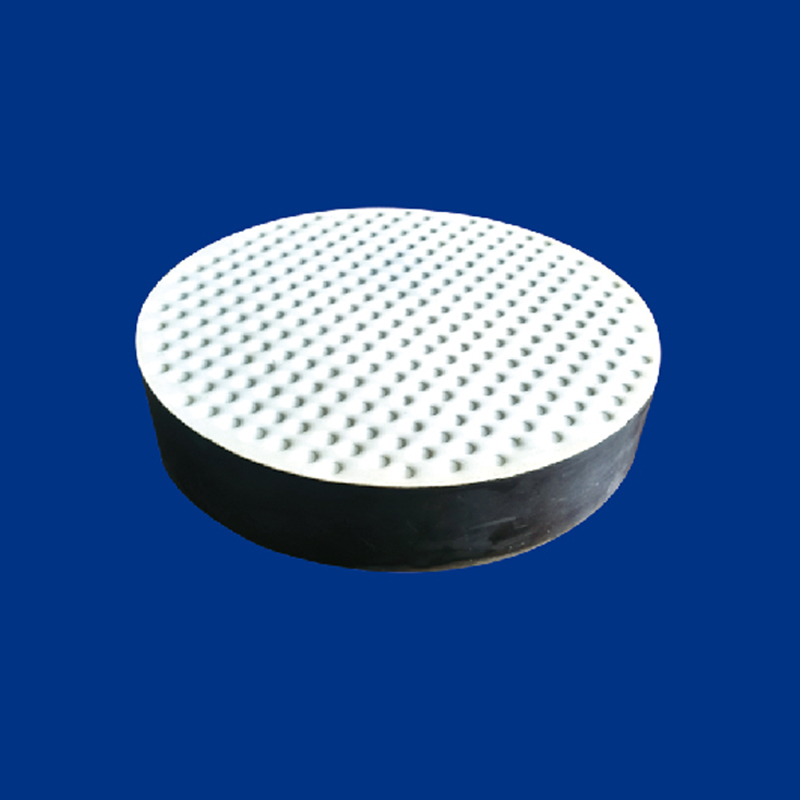



Gansu Juxiang Fluoroplastics Technology Co.,Ltd. is a PTFE Bearing Slider manufacturer serving bridge bearing, structural and vehicle sliding applications. From our Yumen base in Gansu and the group's Zhejiang production site, we compression-mold, sinter and finish high-strength PTFE slider pads in round and square formats, supply filled compounds where duty demands it, and apply single-side sodium treatment when the pad must bond to rubber or metal. The slider range sits alongside our guide tape, piston ring and filled PTFE lines, so a bearing assembly can be supplied as a matched set of fluoroplastic components rather than separate purchases.
PTFE Bearing Slider Range and Format Availability
Sliders are molded from high-strength PTFE suspension resin, sintered, then finished to the ordered diameter or side length and thickness. Standard round pads run from Φ140 mm to Φ1000 mm at 6–8 mm thick; square pads run from 300 × 300 mm to 1000 × 1000 mm at 5–10 mm. Intermediate sizes, recessed profiles and drilled patterns are machined to drawing.
| Slider format | Size range | Thickness | Typical fit |
|---|---|---|---|
| Round | Φ140 – Φ210 mm | 6–8 mm | Small bridge bearings, expansion joints, machine slides |
| Round | Φ240 – Φ340 mm | 6–8 mm | Standard bridge bearing pads, structural rockers |
| Round | Φ415 – Φ636 mm | 6–8 mm | High-load bridge bearings, large structural nodes |
| Round | Φ740 – Φ1000 mm | 6–8 mm | Heavy civil structures, large-area sliding surfaces |
| Square | 300 × 300 – 600 × 600 mm | 5–10 mm | Rectangular bearing pockets, guided sliding plates |
| Square | 800 × 800 – 1000 × 1000 mm | 5–10 mm | Large flat sliding beds, vehicle and plant sliders |
Material Construction and Sliding Behaviour
The unfilled grade is a virgin PTFE slider with a low coefficient of friction, full chemical inertness and no ageing under outdoor exposure. It carries the published property profile below, which is the reference we work to when a project specifies density, tensile strength and elongation.
| Property | Unit | Value |
|---|---|---|
| Apparent density | g/cm³ | 2.10 – 2.25 |
| Tensile strength, min | MPa | ≥30 |
| Elongation at break, min | % | ≥250 |
| Service temperature | °C | −180 to +260 |
Where contact pressure, sliding speed or wear life exceed what virgin PTFE handles comfortably, we move the pad to a filled PTFE compounds grade. Glass fibre, carbon, graphite and PHBA-filled systems raise compressive strength and reduce cold flow while keeping the dry-running character of the base polymer; the filler is selected against load, movement amplitude and the mating surface rather than by a single default recipe.
Application Fit: Bridge Bearings, Rockers and Vehicle Sliders
The pads are built for slow, high-load movement where lubrication is impractical and maintenance access is limited. A PTFE slider carries vertical load through a steel or elastomer backing while allowing translation and rotation at the interface, which is why the material is specified for structures expected to move through thermal cycles for decades.
- Bridge bearing sliders — sliding on stainless steel or PTFE-faced mating plates, taking expansion movement and rotation under traffic load.
- Building rockers and structural nodes — accommodating rotation and translation in steel roof bearings, seismic restraints and façade connections.
- Vehicle and plant sliders — dry-running pads in chassis, lifting equipment and automated transfer systems where oil-free operation is required.
- Matched sealing sets — PTFE guide tape and PTFE piston rings from the same production base when a bearing or cylinder assembly needs several fluoroplastic parts to one drawing set.
Configuration and Assembly Integration
Each slider is configured around the pocket it sits in and the way it is retained. Diameter, side length and thickness follow the bearing drawing; flatness and thickness tolerance are agreed at order stage because they set the installed clearance in the assembly. We finish edges and faces to suit the seating method, whether the pad is recessed, clamped or bonded.
- Single-side sodium treatment — the bonding face is etched so structural adhesive keys to rubber or metal; the sliding face stays untreated and keeps its friction behaviour.
- Filled grades — higher compressive strength and lower wear for heavy vertical load or short-stroke reciprocation.
- Thickness selection — 6–8 mm for round pads, 5–10 mm for square pads, with non-standard thickness reviewed against pocket depth and load.
- Machined features — recesses, chamfers and hole patterns produced to drawing for mechanical fixing.
Production Control and Documentation
Molding pressure, sintering cycle and finishing allowance are monitored through production, and the finished pad is checked dimensionally before packing. Documentation covering the delivered batch and handling guidance accompanies the shipment, including the orientation of a sodium-treated face where bonding is specified. Pads are packed flat and protected against distortion and contamination in transit, with quantities and labelling matched to the purchase order.
Information We Use to Configure Your Solution
A quotation is prepared from the working point of the bearing, not from a size list alone. The following inputs let us fix grade, thickness and treatment in one pass.
- Drawing or sketch with diameter or side length, thickness and any recess or hole pattern.
- Design load and contact pressure, plus whether load is static, cyclic or intermittent.
- Movement type and amplitude — translation, rotation or both — and the expected service life.
- Mating surface material and finish, and whether a stainless steel sliding plate is used.
- Retention method: recessed pocket, mechanical fixing or adhesive bonding to rubber or metal.
- Operating temperature range and any chemical exposure at the bearing location.
- Quantity per size, spare allowance and packing or marking requirements.
Frequently Asked Questions
Which sizes of PTFE bearing slider do you produce?
Round pads from Φ140 mm to Φ1000 mm at 6–8 mm thick and square pads from 300 × 300 mm to 1000 × 1000 mm at 5–10 mm are standard. Sizes between these steps, and pads with recesses or drilled patterns, are machined to drawing; thickness outside the standard range is reviewed against pocket depth and contact pressure before we quote.
Can the slider be bonded into a bearing assembly?
Yes. We apply sodium treatment to one face so the pad accepts structural adhesive for bonding to rubber or metal backing. The opposite face remains untreated PTFE and keeps its sliding performance, and the treated side is identified so orientation is correct during assembly.
What temperature and chemical conditions suit a PTFE slider?
The pads operate from −180 °C to +260 °C and resist acids, alkalis, solvents and outdoor weathering without ageing. For higher contact pressure, slower wear allowance or reduced cold flow, we specify a filled grade instead of virgin PTFE.
What do you need to quote a slider for a project?
Send the bearing drawing or the required diameter, thickness and quantity, together with the load, movement type, mating surface and whether bonding is needed. That set of data is enough for us to confirm grade, treatment and dimensional tolerance and to return a configuration with the quotation.