

 русский
 Deutsch
 عربى
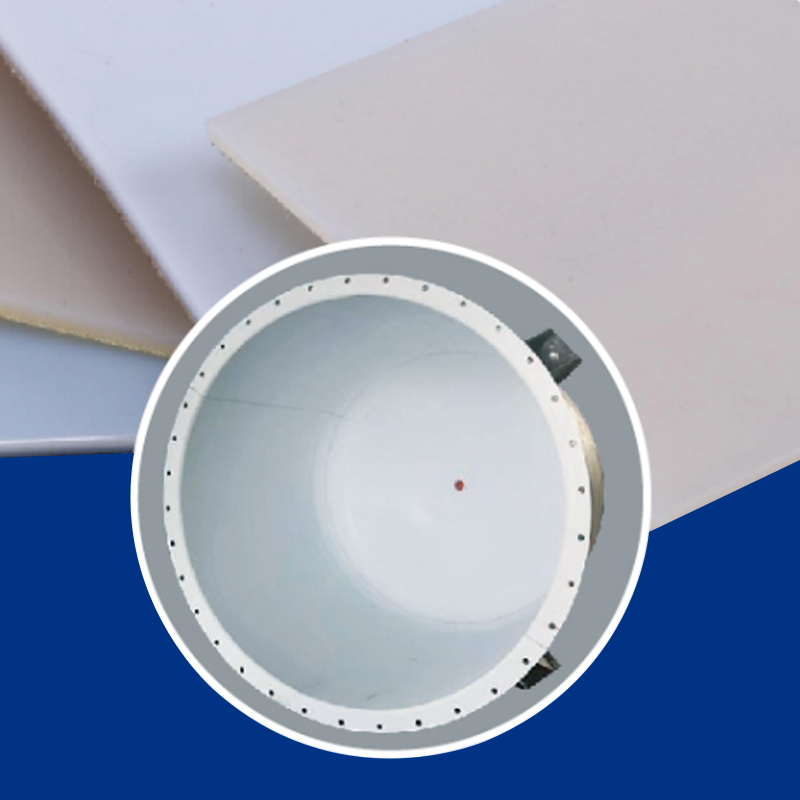


Gansu Juxiang Fluoroplastics Technology Co.,Ltd. produces glass-fiber backed PTFE and modified PTFE sheet at its Yumen base in Gansu, within a fluoroplastic portfolio that also covers sodium-treated PTFE plate, PTFE/PFA composite plate, skived and molded sheet, sealing elements and machined components. As a PTFE M-PTFE Backed Glass Fiber Sheet manufacturer, we laminate the fluoropolymer face to a woven glass fabric backing under controlled heat and pressure, then slit, sheet or cut the laminate to the format a project requires.
The backing is the functional difference. Unsupported PTFE flows under bolt load and is difficult to bond; a glass fabric face gives the sheet an adhesive key to steel, rubber and composite substrates while holding the fluoropolymer in place through thermal cycling. That combination is what makes the material usable for vessel lining, gasket production and anti-stick surfaces rather than only for free-standing components.
Our Range in Glass-Fiber Backed Fluoropolymer Sheet
Three backing chemistries are produced as standard, each aimed at a different balance of mechanical strength, purity and chemical service. Widths run to 1500 mm on the PTFE and M-PTFE grades, which keeps large lining panels and multi-up gasket layouts inside a single piece.
- PTFE backed glass fiber sheet — the general-purpose grade for chemical, electrical and anti-stick duty, with a tensile strength of at least 20 MPa and elongation at break of at least 200%.
- M-PTFE backed glass fiber sheet — modified PTFE face with a denser, less porous structure, giving at least 25 MPa tensile and 250% elongation for gaskets and linings that see higher mechanical stress.
- PFA Backed Glass Fiber Sheet — a melt-processable PFA face for high-purity and elevated-temperature service, with peel strength of at least 15 kgf and a 1200 mm supplied width.
| Grade | Tensile strength, min | Elongation at break, min | Apparent density | Peel strength | Supplied width |
|---|---|---|---|---|---|
| PTFE backed glass fiber sheet | 20 MPa | 200% | 2.13–2.20 g/cm³ | 10–15 kgf | 1200–1500 mm |
| M-PTFE backed glass fiber sheet | 25 MPa | 250% | 2.13–2.20 g/cm³ | 10–15 kgf | 1200–1500 mm |
| PFA backed glass fiber sheet | 20 MPa | 250% | 2.12–2.17 g/cm³ | ≥15 kgf | 1200 mm |
Sheet thickness, backing weave weight and surface finish are set per order. Where a lining has to be bonded on the fluoropolymer side rather than the glass side, we supply sodium-etched PTFE surfaces from the same production chain, which removes the need to source a separate treatment step.
Where the Backing Changes the Application
The laminate is chosen when a plain PTFE sheet would be mechanically or practically wrong: too much creep under compression, no reliable bond to a steel shell, or too much movement during gasket cutting and handling. Matching grade to duty is the first decision in every configuration.
| Application | Typical grade | Why it fits |
|---|---|---|
| Chemical vessel, tank and column lining | PTFE or M-PTFE backed | Inert fluoropolymer face over a bondable glass fabric; the backing limits cold flow at the adhesive line and holds panels flat against the shell. |
| Flange, heat-exchanger and pipe gaskets | M-PTFE backed | Higher tensile and elongation give more margin in narrow cut profiles and resist extrusion under bolt load. |
| High-purity wet processing and semiconductor equipment | PFA backed | Smoother, more uniform PFA face with the strongest peel value in the range; the glass side bonds to carrier panels and ductwork. |
| Chute, hopper and conveyor anti-stick liners | PTFE backed | Low-friction face with a backing that stabilises the sheet at fixing points and prevents the liner from thinning locally. |
| Electrical and thermal barrier components | PTFE backed | Dielectric performance combined with dimensional stability at elevated temperature. |
Service conditions decide the grade more than the shape does. Aggressive acids and solvents at moderate temperature sit comfortably with PTFE; hot, high-purity or strongly oxidising streams favour PFA. Vacuum service, steam cycling and high bolt loads all push the specification toward M-PTFE, because the modified face deforms less and recovers better than the standard grade.
Configuration and Fabrication Options
We deliver the laminate as a material or as a finished part, depending on how much of the conversion the customer wants to keep in-house. Both routes use the same base sheet, so the specification does not change between a roll and a cut component.
- Format — rolls, flat sheets or cut panels, trimmed square to the requested width and length.
- Slitting — narrow widths for tape-style lining strips, joint cover strips and automated gasket presses.
- Gasket conversion — ring, full-face and custom profiles cut from Modified PTFE Gasket grade stock or from the backed sheet itself.
- Surface preparation — sodium etching on the fluoropolymer face for adhesive bonding; the glass fabric side is supplied ready for the customer's adhesive system.
- Thickness — agreed against the lining or gasket duty, with the tolerance stated on the order confirmation.
- Edge finishing — trimmed or radiused edges to suit handling and installation access.
For lining work, we can discuss panel layout, overlap direction and the adhesive compatibility of the glass face before the sheet is cut, because those choices determine whether a panel can be installed without rework on site.
Quality Control and Acceptance
Each batch is produced against an agreed specification and released on measured properties rather than appearance alone. Tensile strength, elongation at break, apparent density, peel strength and width are the parameters we report for this product family, and they are the same values used to qualify a grade at the start of a project.
- Incoming fluoropolymer resin and glass fabric checked before lamination.
- Press parameters recorded per batch for traceability.
- Peel strength tested to confirm the bond between fluoropolymer face and glass backing.
- Density and width verified against the ordered grade.
- Visual inspection for blisters, wrinkles, backing gaps and edge damage.
- Batch identification carried on the roll or sheet label and on shipping documents.
Acceptance criteria are fixed at order stage, including the test method and the sampling position on the roll, so that incoming inspection at the customer's plant reproduces the same result. Certification documents held by the company are supplied with the shipment where the project requires them.
Information We Use to Configure Your Solution
A quotation for glass-fiber backed PTFE sheet is only accurate when the working conditions are known. The points below are what our technical team reviews before confirming grade, thickness and format.
- Fluid or product in contact, concentration and operating temperature, including cleaning and shutdown cycles.
- Service pressure, bolt load or vacuum condition for gasket and lining duty.
- Substrate material and adhesive system, where the sheet is to be bonded.
- Required thickness, width and length, with tolerance expectations.
- Delivery format: roll, flat sheet, slit strip or finished gasket profile, with drawings for cut parts.
- Quantity per release and any scheduled call-off arrangement.
- Inspection and documentation requirements, including test reports and certificates.
- Packaging and marking needs for export handling and site storage.
Rolls and sheets are wound or stacked on rigid cores, wrapped for moisture and dust protection, and marked with grade, batch, width and thickness. Cut gaskets are packed flat to prevent deformation in transit. Where a project spans several release dates, we hold the agreed specification so repeat shipments match the first.
Questions We Answer at Quotation Stage
What is the practical difference between PTFE and M-PTFE backed glass fiber sheet?
The modified grade carries a minimum tensile strength of 25 MPa and 250% elongation at break against 20 MPa and 200% for standard PTFE, with the same 2.13–2.20 g/cm³ density and 10–15 kgf peel strength. In practice the M-PTFE sheet gives more margin in cut gaskets and lining panels that see higher mechanical load or thermal cycling.
Can the sheet be supplied slit to width or cut into finished gaskets?
Yes. We supply full-width rolls and sheets up to 1500 mm on PTFE and M-PTFE grades, slit strips for lining and tape work, and finished ring or profile gaskets cut to drawing. Supplying cut parts removes the customer's own conversion step and keeps the edge quality consistent across a batch.
Which side bonds to the substrate, and how should it be prepared?
The woven glass fabric side is the bonding face and is supplied clean for the customer's adhesive system. Where the fluoropolymer face itself must be bonded, we apply sodium etching to create a bondable surface; this is handled within our own production chain rather than by a third party.
What do you need to quote a lining or gasket project?
Send the medium, operating temperature and pressure, substrate, required thickness and dimensions, plus drawings for any cut parts. With that information we confirm the grade, the width that minimises offcut, the delivery format and the inspection scope, and return a specification with the quotation. Inquiries are answered within 12 working hours.
Related Products and Categories
Our portfolio also includes Products for applications with different operating ranges, interfaces or integration requirements.