

 русский
 Deutsch
 عربى


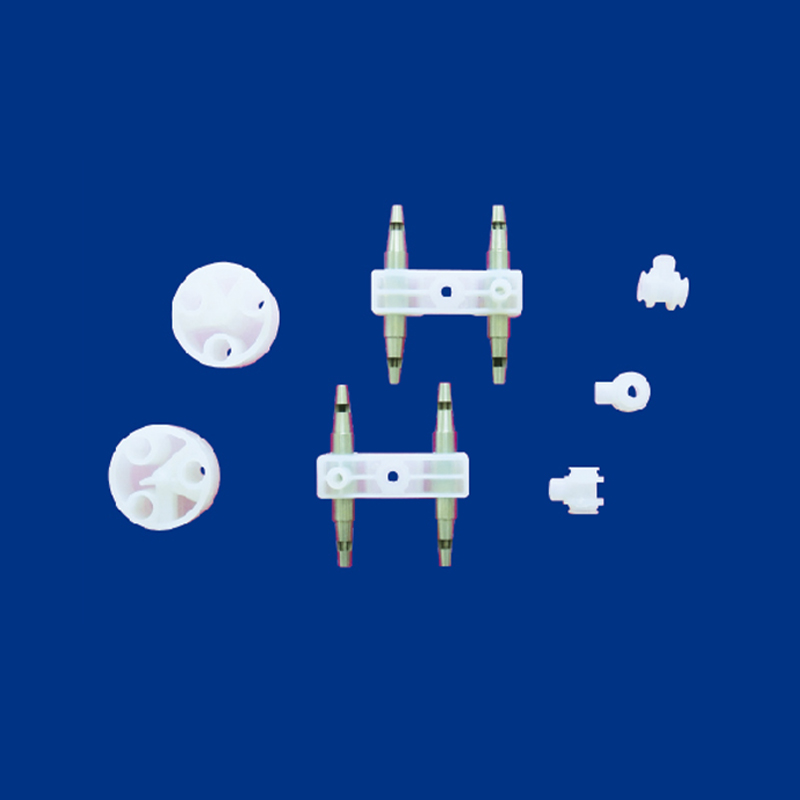
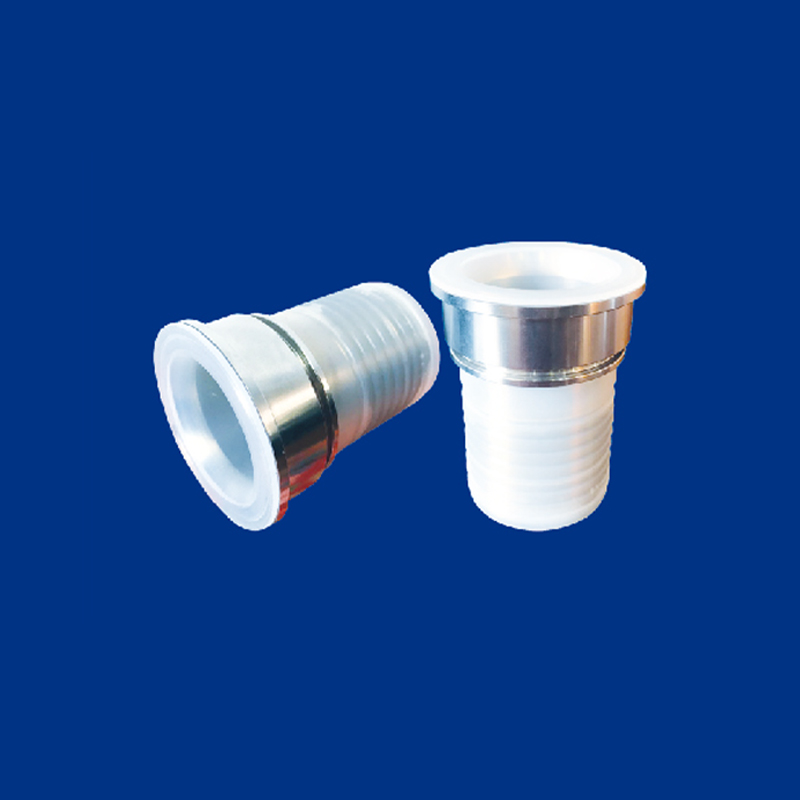



Gansu Juxiang Fluoroplastics Technology Co.,Ltd. produces the PFA Special Connectors, Cable Ties, Special Joints, Ties manufacturer range at its Yumen, Gansu plant, one of two fluoroplastic production bases run alongside the Zhejiang site. The company is a joint venture of Zhejiang Jiaxiang Fluoroplastics and Gansu Juhua New Materials, and this group sits inside a wider fluoropolymer portfolio that also covers PTFE, FEP, PCTFE, PEEK, PI and PVDF. Four families make up the range: PFA special connectors, PFA cable ties, PFA embedded connectors and high-temperature PFA hose connectors.
Almost nothing here is a catalogue item. Each part is produced to drawing or sample because it has to match a specific tube, hose, cable bundle or manifold interface. The shared requirement is a joint or fastening that behaves like the PFA tubing beside it: chemically inert, non-wetting, low in extractables and stable through temperature cycling.
What the Range Covers
Each family answers a different mechanical question on the line, and the configuration inputs differ accordingly.
| Product family | Function in the line | Typical fit | Configuration inputs |
|---|---|---|---|
| PFA special connectors | Non-metallic transition between tube, pipe or port | Acid and high-purity water lines, wet bench plumbing, sampling points | Tube OD and ID, bore, engagement depth, mating thread or barb, overall length |
| PFA cable ties | Bundling and routing cable, tubing and harness | Cleanroom tools, drag-chain runs, wet or chemically exposed cable trays | Bundle diameter, tie length, head style, fixed or releasable, colour |
| PFA embedded connectors | Connector body built around an embedded mating detail | Manifolds and tool interfaces where a straight-through part will not seat | Interface drawing, insert geometry, pull-out load, sealing face |
| High-temperature PFA hose connectors | Hose-to-hose or hose-to-port joint on heated lines | Chemical delivery, hot DI water, thermal cycling circuits | Hose ID, barb or ferrule style, pressure, temperature, media |
Where PFA Earns Its Place
PFA is a fully fluorinated copolymer of tetrafluoroethylene and a perfluoroalkyl vinyl ether. Unlike PTFE it melts and flows, so it can be injection molded, extruded and machined — which is what makes thin-walled connectors and small ties practical in the first place. The polymer keeps PTFE's chemical inertness and low surface energy while giving a smooth, non-porous finished surface.
Melting point sits in the 300–310 °C band, and continuous service ceilings fall in the 260 °C class, so parts hold their shape through hot DI water rinses, acid transfers and the thermal cycling that follows. Low extractables and a non-wetting surface matter where the next thing to touch the part is a wafer, a reagent or an injection line.
- Resistance to acids, bases and most solvents, including the aggressive media used in wafer cleaning and plating.
- No rust, no galvanic couple and no metal ion release where a stainless tie or fitting would contaminate the flow path.
- Low friction and no galling on barbed and push-on joints, so tubing seats without lubricant.
- Not a structural material: sustained load causes creep, so clamp spacing and support points belong in the design.
- Thermal expansion is higher than metal, so long runs need slip allowance rather than rigid anchoring.
Specifications That Decide the Part
- Bore and wall: ID and OD with a stated tolerance class, plus concentricity on thin-wall connector bodies.
- Engagement: insertion depth and barb profile, so the joint bottoms out and seals on the intended face rather than on a thread crest.
- Surface and edges: burr-free rims and no machining marks crossing a sealing face.
- Tie geometry: pawl engagement, tail stiffness, locked loop strength, and whether the tie must be releasable for rework.
- Rating of the assembly: pressure and temperature apply to the finished joint, not to the resin data sheet alone.
- Cleanliness: handling, bagging and packing agreed per project where the part enters a wet bench or a fluid path.
Fitting the Part to the Line
Connectors are usually one element of a tubing system, so we configure them against the tube they join. Where the line is built from our PFA Rod, Tube range, bore and wall thickness are taken from the same drawing set, which removes the mismatch that appears when tube and fitting come from different sources. For extruded runs, the FEP, PFA Extrusion Tube dimensions set the mating geometry.
Cable ties follow the same logic against the harness. Bundle diameter, the number of ties per metre, the radius of the drag-chain or tray route and the temperature at the fixing point all shape the tie length and head design. Where cables run inside a moving chain, tie position and tail orientation are agreed so nothing chafes through a stroke cycle.
Production Control and Acceptance
Parts are machined and formed against the released drawing, with process parameters monitored during the run and finished geometry, wall thickness and edge condition checked before packing. Where a project calls for first-article approval, sample parts are produced for fit-up on the customer's own hardware before the batch is released.
Documentation follows the inspection plan agreed at quotation: material batch reference, dimensional record and packing list, so incoming inspection has a defined set of values to check against rather than a visual impression.
Information We Use to Configure Your Solution
A workable quotation depends on the working point, not on a nominal size alone. These are the inputs that change the part.
| Input | What it determines |
|---|---|
| Drawing or physical sample | Geometry, tolerances and the datum used for inspection |
| Service temperature and cycle profile | Resin grade, wall thickness and allowable creep |
| Media and concentration | Chemical compatibility and surface finish requirement |
| Pressure or vacuum | Wall section, barb depth and joint retention |
| Mating hardware | Thread, barb or push-on interface and engagement depth |
| Cleanliness and packing | Handling, bagging and labelling for the receiving area |
| Quantity and repeat schedule | Tooling route, batch size and stock policy |
| Inspection and documentation | Record content and acceptance criteria |
Questions We Answer Before a Purchase Order
Can you produce PFA cable ties and connectors to our drawing rather than a standard size?
Yes. Custom manufacturing is our core service, and we develop parts strictly to drawings or samples. For ties, send the bundle range, required length, head style and whether the tie must be releasable; for connectors, send the interface drawing and the tube or hose it mates with.
What temperature can these parts run at?
PFA melts in the 300–310 °C band and continuous service ceilings fall in the 260 °C class. The real limit for a connector or tie is set by wall thickness, pressure, media and the number of cycles, so we set the rating against the actual working point rather than quoting a single figure.
How are parts prepared for semiconductor or medical fluid paths?
Handling, cleaning and bagging are agreed per project and stated in the quotation. Parts destined for a wet bench or a reagent line are packed so they arrive with the sealing faces protected and the batch identity intact.
What do you need to quote a special connector?
A drawing or sample, the mating hardware, the media, the temperature and pressure at the joint, the quantity, and the inspection or documentation you expect. With those, we return a configuration and a price against a defined part, not an assumption.
Related Products and Categories
Our portfolio also includes Products for applications with different operating ranges, interfaces or integration requirements.