

 русский
 Deutsch
 عربى





Gansu Juxiang Fluoroplastics Technology Co.,Ltd. manufactures modified PTFE gasket material and finished sealing components in Yumen City, Gansu Province, with a second production base in Zhejiang. Formed as a joint venture between Zhejiang Jiaxiang Fluoroplastics Co., Ltd. and Gansu Juhua New Materials Co., Ltd. of the Juhua Group, we supply fluoroplastic sheet, rod, tube, machined parts and sealing elements from our plants in China into chemical, chlor-alkali, pharmaceutical, semiconductor, new energy and power projects worldwide.
The Modified PTFE Gasket manufacturer programme is built around eight filled grades. Virgin PTFE seals readily but creeps under sustained bolt load, so each grade modifies the base resin with a defined filler to balance compression set, cold flow, thermal expansion and mechanical strength against chemical resistance. Grade selection starts from the flange condition and the process medium rather than from one universal sheet.
The Eight Modified PTFE Gasket Grades
Properties are quoted against ASTM D792 for density, ASTM F152 for tensile strength and ASTM F36 for compression and rebound, so acceptance criteria can be written against the same methods used to publish the data.
| Grade | Filler | Colour | Density g/cm³ | Tensile MPa | Compression % | Rebound % | Typical fit |
|---|---|---|---|---|---|---|---|
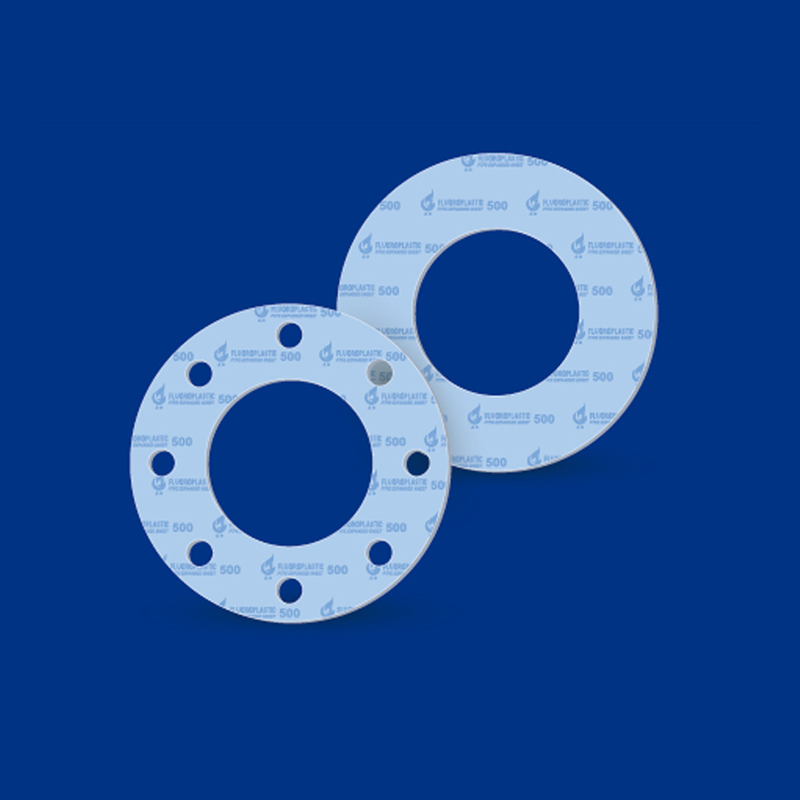
| JUXIANG-G500 | Micro glass bead | Blue | 1.55–1.65 | ≥8 | ≥20 | ≥30 | Low bolt load, warped or uneven flanges |
| JUXIANG-G511 | Silicon dioxide | Yellow | 2.1–2.3 | ≥18 | 8–15 | ≥45 | Chemical, pharmaceutical, semiconductor, precision instruments |
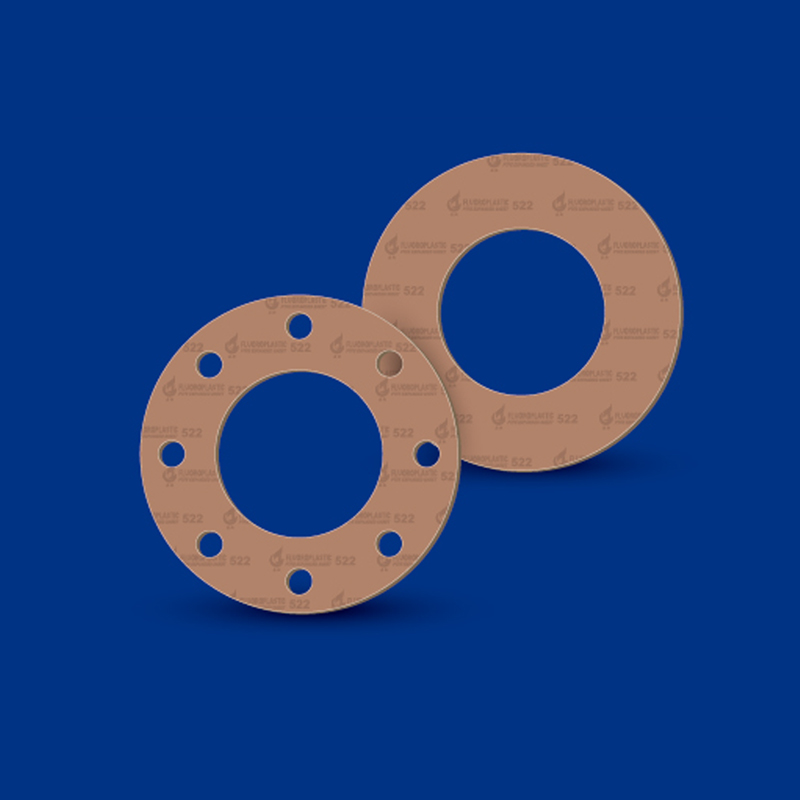
| JUXIANG-G522 | Silicon dioxide | Brown | 2.1–2.3 | ≥18 | 8–15 | ≥45 | Chemical, medical, new energy, high-temperature cycling |
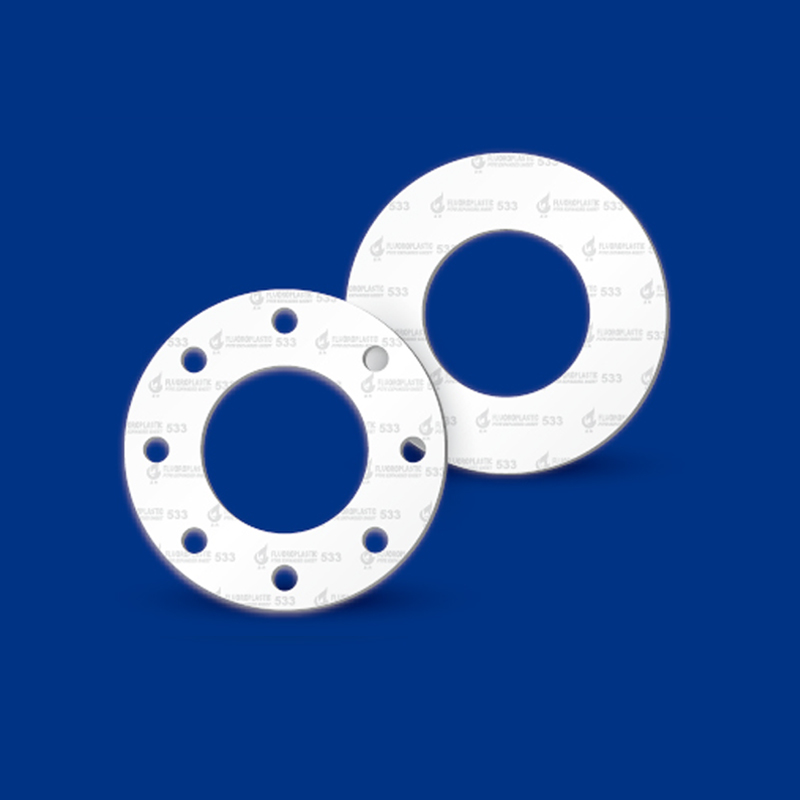
| JUXIANG-G533 | Barium sulfate | White | 2.3–2.5 | ≥10 | 8–15 | ≥45 | Chlor-alkali, acid washing, plating, reciprocating sealing |
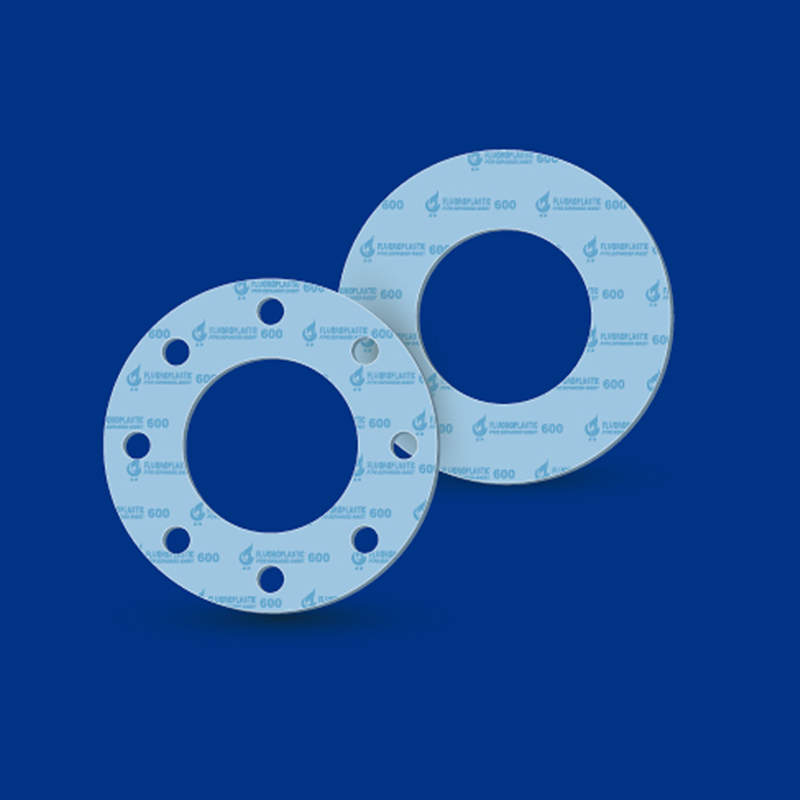
| JUXIANG-G600 | Glass fibre | Blue | 2.1–2.3 | ≥13 | ≥10 | ≥30 | Power, general machinery, hydraulic and pneumatic, water treatment |
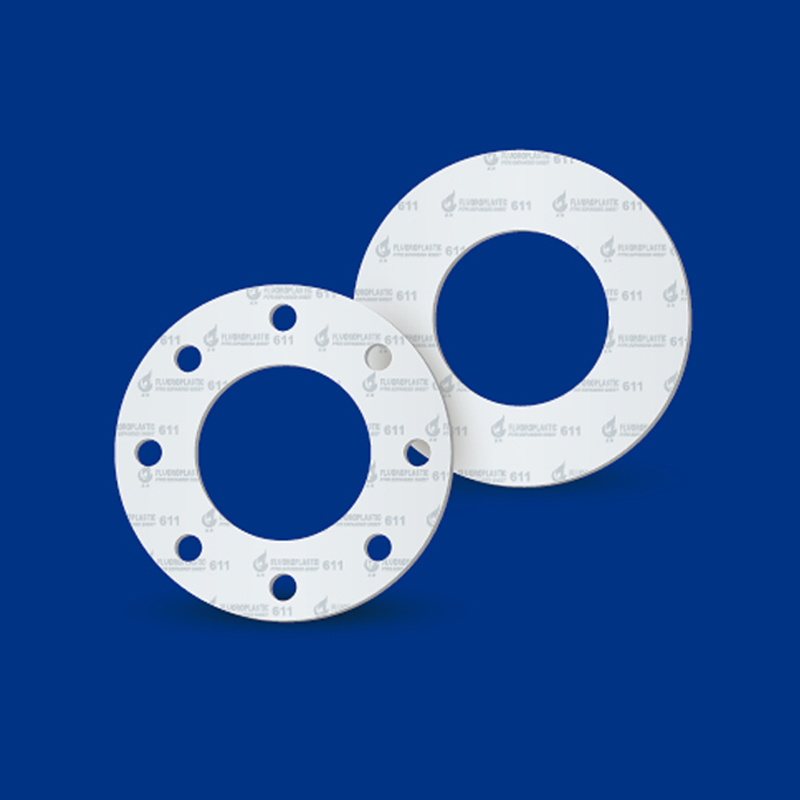
| JUXIANG-G611 | Glass fibre | Light grey | 2.1–2.3 | ≥12 | ≥10 | ≥30 | Power, general machinery, hydraulic and pneumatic, water treatment |
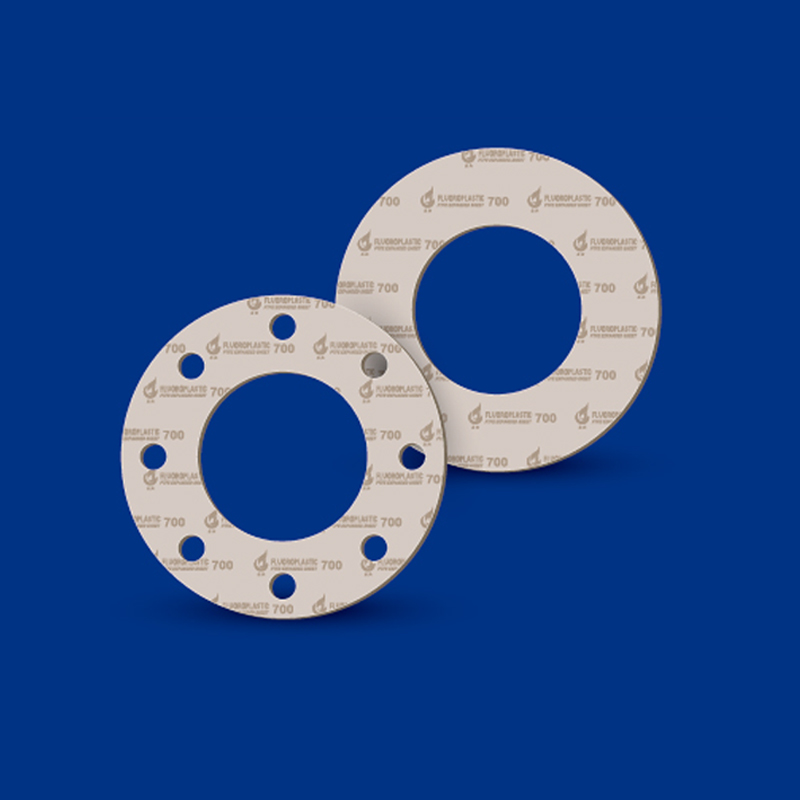
| JUXIANG-G700 | Kaolin | Light brown | 2.1–2.3 | ≥18 | ≥10 | ≥30 | Hot concentrated sulphuric and nitric acid piping |
| JUXIANG-G711 | Carbon black | Black | 2.1–2.3 | ≥12 | ≥10 | ≥30 | Conductive anti-static, petrochemical, fine chemicals, heavy machinery |
G500 carries the lightest filler loading and the highest compressibility in the range, which suits low bolt load and irregular flange faces. G511, G522 and G700 sit at the high-strength end for aggressive chemical duty, while G533, G600, G611 and G711 cover high-density, wear-resistant and conductive requirements.
Application Fit by Process Condition
- Warped, pitted or low-load flanges: G500 micro glass bead sheet compresses at ≥20% and recovers ≥30%, sealing glass-lined, enamel and thin-wall equipment where torque is limited.
- Hot concentrated acids: G700 with kaolin filler is intended for pipelines carrying high-concentration hot sulphuric and nitric acid, where cold flow and creep relaxation drive leakage.
- Chlor-alkali, pickling and electroplating: G533 barium sulfate grade at 2.3–2.5 g/cm³ combines high density with low friction and low wear, and is used for reciprocating and micro-motion sealing as well as static flanges.
- Chemical, pharmaceutical, semiconductor and precision instrument lines: G511 and G522 silica-filled grades give ≥18 MPa tensile with ≥45% rebound, holding bolt load through thermal cycling.
- Power, water treatment, hydraulic and pneumatic equipment: G600 and G611 glass fibre grades provide compressive strength and wear resistance where mechanical robustness matters more than purity.
- Conductive and anti-static service: G711 carbon black grade delivers conductive anti-static performance with good thermal conduction for petrochemical, fine chemical and new energy equipment requiring static dissipation.
Gasket Formats and Composite Construction
Material is supplied as Modified PTFE Sheet for in-house cutting, or as finished rings cut and machined to drawing. Thickness, inside and outside diameter, bolt circle and tongue-and-groove profiles are fixed at quotation against the flange standard in use.
- Full-face and raised-face ring gaskets, plus non-standard profiles from customer drawings.
- Large-diameter sealing frames and vessel closures produced as a large integrated molded PTFE sealing frame and gasket where a spliced ring is not acceptable.
- Reinforced and backed constructions for blow-out resistance or handling stiffness; the Expanded PTFE Reinforced Flange Gasket range covers the softer, high-conformability end of the same duty.
- Edge marking, tagging and batch identification agreed per order.
Critical Specifications and Configuration Control
Four variables decide whether a modified PTFE gasket holds its torque over a service cycle: density, compression and rebound behaviour, creep relaxation under load, and the dimensional fit of the ring in the flange. We fix all four at the quotation stage.
- Density: 1.55–1.65 g/cm³ for the compressible G500 sheet, 2.1–2.5 g/cm³ for the filled grades; density drives permeability and cold flow resistance.
- Compression and rebound: quoted as ranges per ASTM F36 so gasket seating stress can be matched to the available bolt load.
- Tensile strength: from ≥8 MPa to ≥18 MPa depending on grade, relevant where gaskets are handled repeatedly or exposed to pressure spikes.
- Media and temperature: filler chemistry sets resistance; silica and barium sulfate grades cover a broad chemical spectrum, while glass fibre grades are not intended for hydrofluoric acid or hot strong alkali.
- Geometry: thickness, diameter and flatness tolerances confirmed against the flange drawing, including bolt-hole alignment and centring.
Quality Data and Acceptance
Grade and batch identification are marked on the shipment so supplied material can be traced to its formulation record. Inspection scope, dimensional reporting and any agreed witness points are confirmed when the order is placed.
- Density, tensile, compression and rebound reported against the ASTM methods listed in the grade table.
- Dimensional inspection of finished rings against the approved drawing.
- Visual acceptance criteria for cuts, edge quality, delamination and surface defects.
- Packaging that protects flatness and prevents deformation in transit, with grade and batch marking on the outer carton.
Installation, Handling and In-Service Life
Modified PTFE gaskets are single-use components. Sealing performance depends as much on flange preparation and bolt-up as on the sheet itself.
- Clean and inspect flange faces; remove old gasket residue and check for pitting, warping and radial scores.
- Centre the gasket on the bolt circle and keep the sealing faces dry.
- Tighten in a cross pattern in stages to the torque calculated from the gasket seating stress and the bolt grade.
- Store flat, out of direct sunlight and away from oil and ozone sources; never reuse a compressed gasket.
Information We Use to Configure Your Solution
A proposal is prepared from the working point rather than from a catalogue number. The following inputs let us fix grade, format and acceptance scope in one pass.
- Process medium, concentration and phase, including trace aggressive species.
- Operating and design temperature and pressure, plus cycling or thermal shock.
- Flange standard, nominal size, pressure class, face type and available bolt load.
- Gasket drawing or dimensions: ID, OD, thickness, bolt circle, bolt holes, groove details.
- Conductivity or anti-static requirement, and any cleanliness or purity class.
- Quantity, spare allowance, packaging and marking requirements.
- Acceptance documentation and any third-party inspection arrangement.
Frequently Asked Questions
How do I choose between G500 and G511?
G500 is the micro glass bead grade at 1.55–1.65 g/cm³ with ≥20% compression, built for low bolt load and uneven or warped flanges. G511 is a silica-filled grade at 2.1–2.3 g/cm³ with ≥18 MPa tensile and ≥45% rebound, giving better creep resistance and torque retention on machined flanges in chemical, pharmaceutical and semiconductor service.
Can you supply gaskets to our own drawing?
Yes. We cut and machine modified PTFE gaskets to customer drawings and samples, including non-standard profiles, large-diameter frames and multi-part sets. Send the drawing with the flange standard and quantity, and we will confirm grade, thickness and tolerance.
Which grade suits hot concentrated sulphuric or nitric acid?
G700, the kaolin-filled grade at 2.1–2.3 g/cm³ with ≥18 MPa tensile, is the one we specify for pipelines carrying high-concentration hot sulphuric and nitric acid, where cold flow and creep relaxation are the dominant failure modes.
Do you make anti-static or conductive gaskets?
G711 uses carbon black filler to give conductive anti-static performance with good thermal conduction, and is used in petrochemical, fine chemical, hydraulic and new energy equipment where static dissipation is required. Tell us the conductivity requirement and we will match the grade to your specification.