

 русский
 Deutsch
 عربى






PFA Expansion Joint Range from a Fluoroplastic Manufacturer
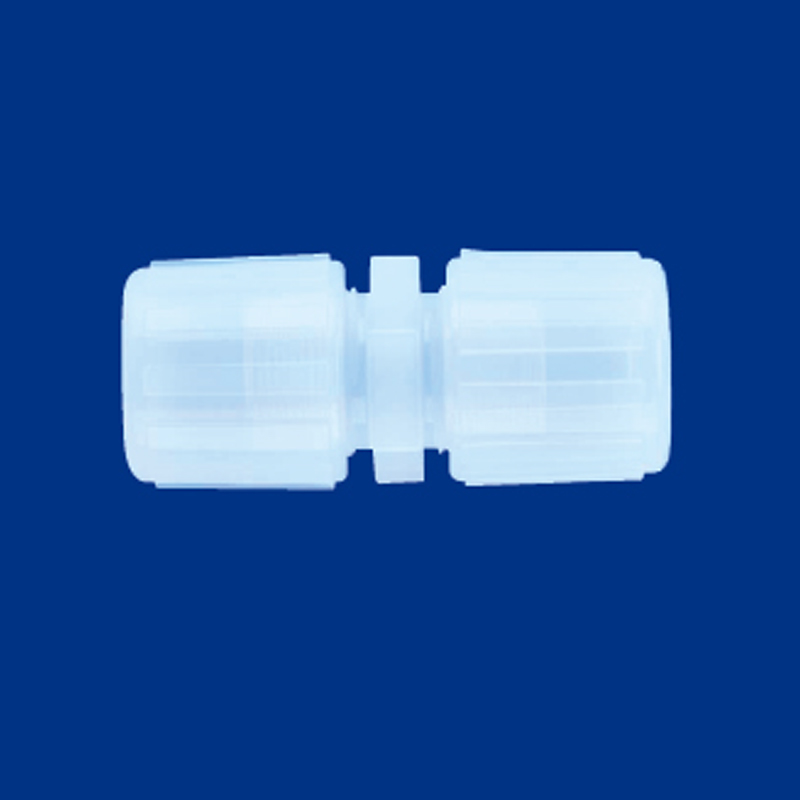
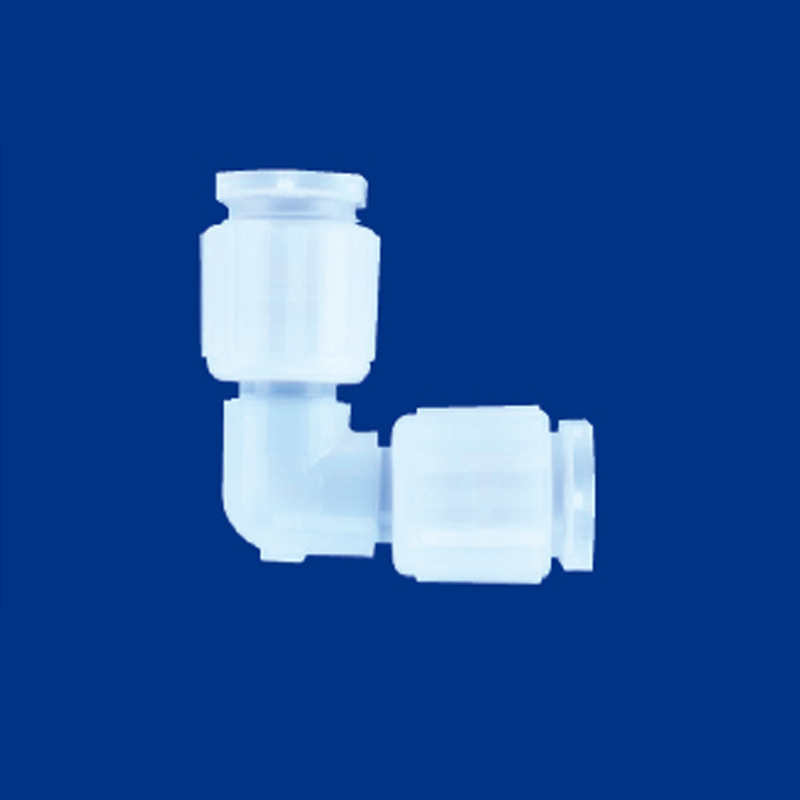
Gansu Juxiang Fluoroplastics Technology Co.,Ltd. manufactures the PFA Expansion Joint range at our Yumen, Gansu plant, with a second fluoroplastic production base in Zhejiang behind it. The range is a family of flare-connected PFA fittings — union tees, straight unions and union elbows — from 1/4 in to 1-1/2 in tube OD, supplied as loose components or as tube-and-fitting assemblies for high-purity chemical, semiconductor and water-treatment lines.
Our PFA Expansion Joint range is produced to the dimensions below and to customer drawings where a standard part does not fit the envelope. Because the same group extrudes PFA rod and tube and machines PTFE, PFA, PEEK and PVDF components, material source, machining practice and dimensional inspection stay inside one quality system rather than being split across a trading chain.
- Flare-connection PFA fittings for 1/4 in to 1-1/2 in tube
- Union tee, straight union and union elbow bodies, including space-saver configurations
- Standard parts held to fixed millimetre dimensions; custom geometry built to drawing
- Assemblies with PFA tube, cut and flared to the routing you supply
Product Range and Application Fit
Three body styles cover most of what a PFA line needs at a joint: a branch, an in-line splice and a direction change. Each is offered across the tube range, with orifice and envelope scaled to the tube size so flow area and bend radius stay consistent with the run.
| Body style | Part number | Tube OD | Orifice | A | B | C | D |
|---|---|---|---|---|---|---|---|
| Union tee, flare / space saver | D-G1-UT4S-FA | 1/4 in | 3.8 | 84 | 15.4 | 15.4 | 42 |
| Union tee, flare / space saver | D-G1-UT8S-FA | 1/2 in | 9.6 | 94 | 18.1 | 18.1 | 47 |
| Union tee, flare / space saver | D-G1-UT16S-FA | 1 in | 22.3 | 139 | 33.2 | 33.2 | 69.5 |
| Straight union | D-G1-SU4-4-FA | 1/4 in | 3.8 | 66 | 24.6 | 17.4 | — |
| Straight union | D-G1-SU12-12-FA | 3/4 in | 16 | 84 | 32.8 | 30.1 | — |
| Straight union | D-G1-SU24T-24T-FA | 1-1/2 in | 33.7 | 168 | 55 | 61 | — |
| Union elbow, flare / space saver | D-G1-UE4S-4S-FA | 1/4 in | 3.8 | 41.5 | 15.4 | — | — |
| Union elbow, flare / space saver | D-G1-UE12S-12S-FA | 3/4 in | 16 | 54 | 29.2 | — | — |
| Union elbow, flare / space saver | D-G1-UE20S-20S-FA | 1-1/4 in | 27.9 | 78.5 | 43.1 | — | — |
The space-saver designation on the tee and elbow refers to the reduced centre-to-face envelope: the B and C dimensions are held equal on the tee so the body sits closer to a manifold face, which matters where several lines run in parallel inside a wet bench or a fume hood.
- Union tee — header branches, sampling points and sensor take-off on a common run
- Straight union — joining extruded tube lengths, replacing a damaged section, transitioning between two tube lots
- Union elbow — 90-degree turns at the tight radii typical of tool enclosures and skid frames
Working Point: Temperature, Pressure and Media
PFA carries the chemical resistance and purity of PTFE while remaining melt-processable, which is why it is the usual choice for wetted fittings in high-purity lines. Continuous service is generally quoted around 260 °C with melting in the 300–310 °C region, so the fitting body is rarely the limiting item in a chemical or DI-water circuit; the tube, the nut and the flare torque usually are.
Thermal movement and chemical exposure
PFA expands roughly an order of magnitude more than stainless steel over the same temperature rise. A straight run that grows a few millimetres between ambient and 90 °C will load a rigid connection if there is no compliant length; a flare-connected joint with a short offset absorbs that movement and the pump vibration that comes with it. Against acids, solvents and oxidisers the material is effectively inert, and its low surface energy limits scale build-up and shortens rinse time.
Pressure and support
No single pressure figure applies across the range. Working pressure depends on tube OD and wall, on temperature, on nut torque and on how the run is supported. We confirm the rating for the specific assembly — tube, fitting and connection together — rather than quoting a blanket number that would not hold at 1-1/2 in and 80 °C.
Flare Geometry, Orifice and Dimensional Control
The flare connection is where a PFA joint either seals or weeps. Cone angle, sealing-face finish and the squareness of the cut tube end all matter, and so does the nut: over-torque cold-flows the flare, while under-torque leaves a leak path that only appears after thermal cycling.
- Orifice matched to tube ID so the joint does not become the flow restriction in the line
- A dimension fixed by the assembly envelope; B, C and D set clearance to adjacent lines and to the enclosure wall
- Flare face checked for concentricity and surface condition before packing
- Re-torque guidance issued with assemblies that see repeated heating and cooling
Configuration, Quality and Delivery Scope
Configuration options
Standard parts cover 1/4 in to 1-1/2 in tube. Beyond that we work from drawings: metric tube sizes, reducing tees, extended leg lengths, non-standard orifice, panel-mount or threaded transitions using our PFA special connectors and joints, and complete assemblies built on PFA Rod, Tube or FEP, PFA Extrusion Tube.
Quality and acceptance
Inspection is dimensional and visual against the drawing: tube OD, orifice, the A/B/C/D envelope, flare cone and face condition, and nut thread. Material batch is recorded against the order so a delivered lot traces back to its resin batch. The documentation package — material certification, dimensional record and batch identification — is agreed at order stage, and where a project calls for witnessed inspection we fix the inspection plan before production starts.
Packaging and delivery scope
Parts are bagged individually or in agreed quantities, with flare faces capped, and packed for export under the labelling you specify. Cleanliness level, double-bagging and any cleanroom handling requirement are settled before production rather than after.
Information We Use to Configure Your Solution
A quotation that holds up in service starts from the working point, not from a part number alone. These inputs let us size the joint, confirm the rating and quote without a second round of questions.
- Tube OD and wall, or the tube part number already installed in the line
- Design pressure, design temperature and the cycling between them
- Medium and concentration, and whether the circuit is high-purity or general chemical service
- Flow rate or allowable pressure drop, so the orifice can be checked against the duty
- Available envelope: A, B, C and D limits, plus spacing to adjacent lines
- Connection standard, or a sample flare for matching
- Quantity, spares allowance, and whether loose fittings or finished assemblies are required
- Documentation, inspection and cleanliness requirements
- Delivery destination and packing preference
Questions We Answer Before an Order
What tube sizes does the PFA Expansion Joint range cover?
Standard union tees, straight unions and union elbows run from 1/4 in to 1-1/2 in tube OD, with orifice from 3.8 mm to 33.7 mm. Metric tube and sizes outside the table are machined to drawing, including reducing tees and extended leg lengths.
Can you supply complete assemblies rather than loose fittings?
Yes. We build tube-and-fitting assemblies with flared ends, cut to the A dimension you specify, and can include tees and elbows in the same assembly. A routing sketch or 3D model is enough to work from.
How is the pressure rating established?
We confirm it per assembly from tube OD and wall, service temperature, nut torque and support arrangement. The proposal states the rating for the actual configuration you are installing, not a catalogue maximum.
What documentation accompanies a shipment?
Material certification, dimensional inspection records and batch identification are issued as standard, with the exact package agreed at order stage. Where a project requires witnessed inspection, the inspection plan is fixed before production.