

 русский
 Deutsch
 عربى
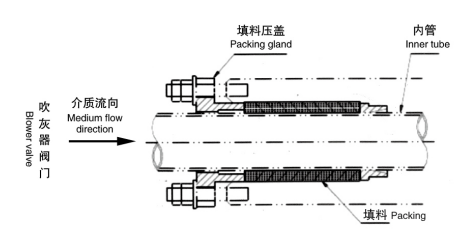
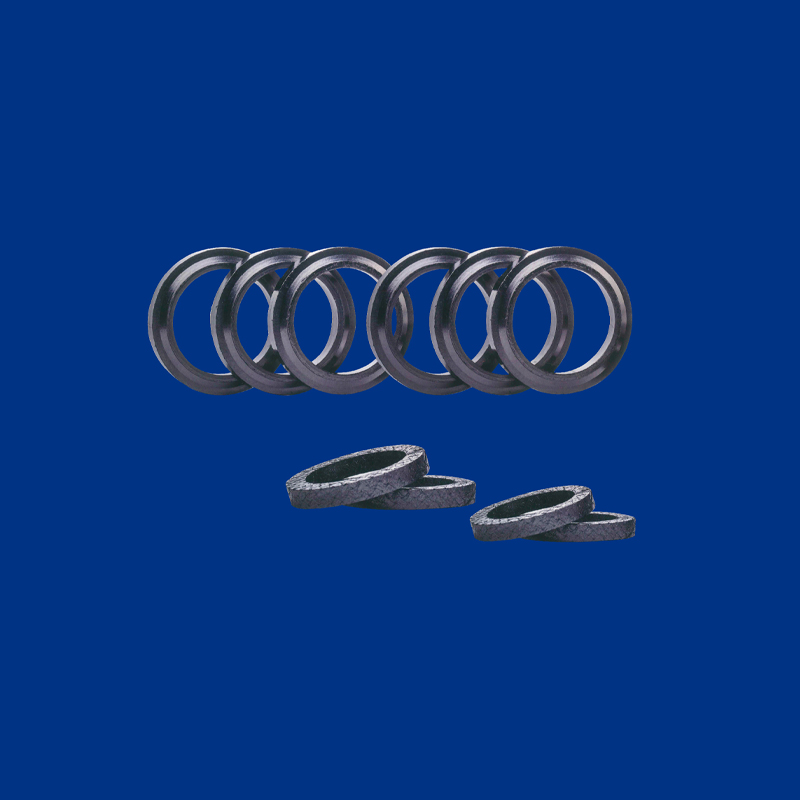


Gansu Juxiang Fluoroplastics Technology Co.,Ltd. is a Soot Blower Packing Gasket manufacturer supplying the composite ring stacks that seal the lance penetration and valve stem of soot blowers in coal-fired boilers. The construction pairs nickel wire-reinforced end rings, which carry the gland load and resist the scraping action of the inner tube, with graphite molded rings that hold a tight fit on both the inner and outer diameter. We build to drawing, with maximum outside diameters from Φ15 mm to Φ120 mm and thickness set by the customer's stuffing box.
Range at a glance
- Composite stack: nickel wire-reinforced end rings plus graphite molded rings
- Stroke 7–14 m; steam or compressed air blowing medium
- Steam service 180 °C – 250 °C at 0.8 – 2.0 MPa
- Maximum outside diameter Φ15 mm – Φ120 mm, thickness to customer requirement
- Produced across our Zhejiang and Gansu bases, with drawing-based customization as standard
Where the Packing Sits in the Soot Blower
A soot blower keeps the boiler's heating surfaces clear by firing steam or compressed air through a lance that travels into the furnace and rotates as it advances. Ash and slag build-up on superheater and economiser surfaces cuts heat transfer and can force an unplanned shutdown, so the blower runs on a fixed cycle. The packing is the static-to-moving seal at the point where that lance leaves the boiler envelope, and at the valve stem that admits the blowing medium.
- Wall box penetration. The lance tube passes through the boiler wall and is never perfectly concentric; the packing must seal against a moving tube while hot and slightly eccentric.
- Valve stem. The admission valve strokes with every blowing sequence, so stem packing sees repeated pressure shocks rather than steady load.
- Gland follow-up. Packing compresses over service life; the gland has to take up that loss without crushing the rings.
- Abrasive environment. Fly ash on the exposed tube acts like a lapping compound on the packing bore, which is why the end rings carry a wire reinforcement.
Ring Construction and Material Logic
Each element in the stack does a different job, and the seal is only as good as the interface between them. The disc-shaped ring profile is what allows the assembly to hold under the modest cover loads typical of a soot blower gland.
| Element | Function | Engineering reason |
|---|---|---|
| Nickel wire-reinforced end ring | Carries compression and resists extrusion at the gland | Withstands high temperature, high pressure and the scraping action of the inner tube |
| Graphite molded ring | Forms the sealing body of the stack | Ensures a tight fit between inner and outer diameters |
| Disc-shaped profile | Maintains contact at low gland load | Delivers sealing effect under low-pressure cover loads |
| Inner diameter fit | Sets clearance to the lance tube or stem | Too loose leaks; too tight scores the tube and raises actuation force |
Operating Envelope We Build To
The packing is specified against the blower's duty rather than a generic temperature class. These are the conditions the range is built for, and they define the questions we ask before quoting.
| Parameter | Range |
|---|---|
| Stroke | 7 – 14 m |
| Blowing medium | Steam or compressed air |
| Propulsion speed | 0.8 – 3.5 m/min |
| Rotation speed | 9 – 35 rpm |
| Temperature (steam) | 180 °C – 250 °C |
| Pressure | 0.8 – 2.0 MPa |
| Maximum outside diameter | Φ15 mm – Φ120 mm |
| Thickness | As per customer requirements |
Where a blower falls outside these bands, or the stuffing box has been re-machined in service, the geometry is built to the drawing rather than forced into a standard size. Other specifications are quoted on consultation.
The Range Around the Packing
A boiler house rarely needs one sealing item in isolation. Our fluoroplastic product range covers the joints and seals that sit alongside the soot blower on the same unit, so a single order can carry the whole sealing scope.
| Product | Where it fits |
|---|---|
| Soot Blower Packing Gasket | Lance wall box and valve stem on retractable and rotary soot blowers; also supplied as special packing for the blower valve stem |
| Expanded PTFE Reinforced Flange Gasket | Blowing-medium supply pipework, steam headers and air lines feeding the blower |
| Modified PTFE Gasket | Chemical and power-plant flanged joints requiring low creep under bolt load |
| Braided gland packing and PTFE universal seals | General valve and pump glands elsewhere in the boiler house where a softer, conformable packing is preferred |
Configuration Options
Most soot blower packing orders are not a single part number. The stack is assembled to the gland it has to fill, and the following choices are settled before production.
- Ring count and stack height matched to the measured stuffing box depth.
- End ring position — top, bottom or both ends of the stack, depending on which face sees the scraping and the pressure.
- Split rings for in-situ replacement where the lance cannot be withdrawn on the outage schedule.
- Inner diameter tolerance and radial clearance set against the measured lance or stem diameter, including wear and ovality.
- Chamfer and lead-in on the end rings to ease fitting over the tube without shaving the ring bore.
- Thickness to customer requirement, including non-standard or re-machined gland depths.
- Set marking and packing sequence so rings go into the gland in the intended order.
Installation, Break-In and Spares
The composite stack behaves differently from a soft braided packing, and the fitting routine reflects that. The disc profile seals at low cover load, so over-tightening the gland buys nothing and costs ring life.
- Seat each ring squarely in the box; stagger joints on split rings around the shaft.
- Bring the gland down evenly and check that the lance still strokes and rotates freely.
- Run the first blowing cycles and watch the wall box and stem for carry-over before the boiler returns to normal cycling.
- Re-check gland load after the first heat cycle, when the stack has taken its initial compression.
- Hold one spare set per blower on site; the packing is a consumable and replacement is planned, not reactive.
Information We Use to Configure Your Solution
A workable proposal needs the blower, the gland and the duty — not just a diameter. This is the input set we work from, and partial data is enough to start the discussion.
- Blower make, model and type — retractable or rotary
- Lance tube outside diameter, measured on site, plus any ovality or wear
- Stuffing box bore, depth and the number of rings currently fitted
- Stroke length, propulsion speed and rotation speed
- Blowing medium, pressure and temperature at the gland
- Valve stem diameter and gland dimensions for stem packing sets
- Drawing or physical sample where the geometry is non-standard
- Quantity per boiler, spares policy, and required marking or set packaging
Quality, Documentation and Delivery
Rings are checked against the agreed drawing before they are packed, and each shipment carries the documentation and fitting guidance needed on site. Because we run production across two bases in Zhejiang and Gansu, repeat boiler-house orders can be scheduled without disrupting the custom machining work that shares the same capacity.
- Drawing-based dimensional verification of bore, outside diameter, thickness and stack height.
- Documentation and usage guidance issued with the order.
- Sets packed to preserve ring order and protect the graphite rings in transit.
- Custom manufacture to drawings or samples, which is the core of our service model.
Frequently Asked Questions
What is a soot blower packing gasket made from?
The stack combines nickel wire-reinforced end rings with graphite molded rings in a disc-shaped profile. The reinforced end rings withstand high temperature, high pressure and the scraping action of the inner tube, while the graphite molded rings ensure a tight fit between the inner and outer diameters. The disc profile maintains the seal under low-pressure cover loads.
What sizes and thicknesses can you supply?
Maximum outside diameter runs from Φ15 mm to Φ120 mm, and thickness is produced to customer requirements rather than held to a fixed list. Non-standard bores, stack heights and ring counts are built to drawing; other specifications are quoted on consultation.
Can you supply packing for the soot blower valve stem as well as the lance?
Yes. Special packing for the soot blower valve stem is part of the same range. Send the stem diameter, gland bore and depth, and the medium pressure and temperature at the valve, and the set is built to suit that gland rather than adapted from the lance size.
Which operating conditions does the range cover?
Stroke 7–14 m, steam or compressed air as the blowing medium, propulsion speed 0.8–3.5 m/min, rotation 9–35 rpm, steam temperature 180 °C to 250 °C and pressure 0.8–2.0 MPa. Blowers running outside these bands are handled as drawing-specific builds, so the duty data matters more than the nominal size.