
 русский
 Deutsch
 عربى



Gansu Juxiang Fluoroplastics Technology Co.,Ltd. produces the PTFE Dust-free Towing Chain Jacket inside our semiconductor equipment cable-protection range, alongside PTFE, PFA, FEP, PCTFE, PEEK and PI sheet, rod, tube and machined components. The jacket is an open-structure PTFE wrap that closes around a cable carrier already in service: cables, gas lines and the drag chain stay where they are, and the wrap goes on around them.
As a PTFE Dust-free Towing Chain Jacket manufacturer, we build to the published size codes below or to a drawing or sample when a carrier falls outside them. Production is scheduled across our Zhejiang and Gansu bases, and quotations are prepared from the carrier model, the cable bundle and the machine's travel data rather than from a catalogue assumption.
What the Jacket Solves on a Moving Cable Carrier
Every towing chain on a wafer tool, wet bench, handler or automated assembly line carries a mix of power cables, signal cables and tubing. As the chain articulates, the links generate particles and the cables abrade against one another. A closed jacket contains that debris at the source and holds the bundle together through the full stroke.
Because the structure is open along its length, the jacket is fitted without breaking the cable run. On a tool that is already qualified, that means no re-termination of the harness, no repeat validation of the cable set and no extended downtime window.
- Semiconductor front-end and back-end tools — wafer handling, wet cleaning, inspection and test equipment where particle control and static discipline govern the cleanroom class.
- Mechanical equipment link cables — general automation, linear axes and gantry systems with reciprocating carriers.
- Retrofit and maintenance access — jackets added to existing chains during a scheduled shutdown, and opened again for cable service without dismounting the chain.
- Gas and fluid tubing runs — tube bundles routed alongside cables in the same carrier.
Range, Size Codes and Width Selection
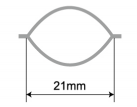
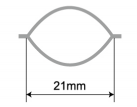
Two jacket body widths are produced: 21 mm and 28 mm. Within each body, the part number fixes the single width, the POD quantity and the width band the jacket covers. The 21 mm body spans a 42 mm minimum to a 169 mm maximum; the 28 mm body spans 56 mm to 218 mm.
| Part No. | Single width (mm) | POD qty (pcs) | Max. width (mm) | Min. width (mm) |
|---|---|---|---|---|
| POD21-U-2 | 2 | 2 | 68 | 42 |
| POD21-U-3 | 3 | 3 | 77 | 63 |
| POD21-U-4 | 4 | 4 | 100 | 84 |
| POD21-U-5 | 5 | 5 | 123 | 105 |
| POD21-U-6 | 6 | 6 | 146 | 126 |
| POD21-U-7 | 7 | 7 | 169 | 147 |
| POD28-U-2 | 2 | 2 | 68 | 56 |
| POD28-U-3 | 3 | 3 | 98 | 84 |
| POD28-U-4 | 4 | 4 | 128 | 112 |
| POD28-U-5 | 5 | 5 | 158 | 140 |
| POD28-U-6 | 6 | 6 | 188 | 168 |
| POD28-U-7 | 7 | 7 | 218 | 196 |
Selection starts with the outer width of the carrier and the cross-section of the bundle inside it. Where the bundle is dense, or the chain runs a long stroke at speed, we move to the wider body so the wrap keeps clearance through the bend radius instead of loading the cable insulation.
Material Behaviour and Cleanroom Fit
The jacket is made in PTFE, chosen for the combination that matters on a moving carrier: a low-friction, non-marking contact surface, chemical inertness against cleaning agents and process residues, and stable behaviour across the temperature range the tool sees. The material does not shed the way textile wraps do, and it does not take on a stiff memory shape that fights the chain's articulation.
- Low coefficient of friction against cable jackets and tubing, reducing drag on the bundle through the stroke.
- Inert to acids, bases, solvents and the standard cleanroom wipe-down chemistries.
- Non-marking, non-abrasive contact surface — no adhesive residue left on the cable.
- Anti-static construction available as part of the complete dust-free solution where the line requires charge dissipation.
- Retains flexibility at the fold rather than cracking at the bend radius.
Installation, Line Integration and Auxiliary Parts
Fitting is a wrap-and-close operation performed around the chain in place. The jacket follows the carrier through its full travel, including the reverse bend, and is opened again for cable replacement or for adding a line to the bundle — which is what makes later equipment modification practical without a harness rebuild.
We supply the jacket together with the parts that complete the run where a project calls for them: PFA special connectors, cable ties and joints for bundling and termination, plus PTFE Guide Tape or PTFE Self-Lubricated Tape where a sliding interface sits next to the carrier. Because these items come from the same fluoroplastic production, the jacket and its accessories arrive as one matched set rather than three separate purchases.
Quality, Documentation and Delivery Scope
Each jacket is checked against the approved drawing before packing: overall width against the selected size code, edge finish, wrap continuity and closure integrity. The check is dimensional and visual, and it is recorded against the order line so a repeat order reproduces the same geometry.
Shipments travel with the documentation package for the order — part numbers, dimensions and quantity per size code — together with handling and fitting guidance so a maintenance team can install without a call-back. Jackets are packed to protect the wrap edges in transit, consolidated by size code and by carrier run.
Custom manufacturing is our core service. Jackets are built to drawing or sample where a carrier falls outside the published bands, and matched sets are produced for a tool carrying several chain sizes. Our joint-venture structure, with production in Zhejiang and Gansu, lets us schedule volume across two sites and keep a stable supply position for global accounts.
Information We Use to Configure Your Solution
A workable proposal needs the carrier, the bundle and the machine duty. This is the input set we work from; where a value is not yet fixed, we start from the carrier drawing and confirm the remainder at sample stage.
- Carrier data — make and model, inner and outer width, link pitch, bend radius, fixed-end and moving-end positions.
- Bundle — number and outside diameter of cables, hoses and tubes, plus any connector that must pass through the wrap.
- Duty — travel length, speed and acceleration, cycles per shift, mounting orientation (horizontal, vertical, unsupported).
- Environment — cleanroom class, static-dissipation requirement, ambient and process temperature, cleaning chemistry, wash-down frequency.
- Size code — jacket body width (21 mm or 28 mm), part number, length per run, number of runs per tool.
- Commercial scope — quantity per size code, spare allowance, labeling and packaging requirements, delivery destination.
Customer Questions
Can the jacket be fitted without dismantling the cable carrier?
Yes. The open structure wraps directly around the chain, so cables, gas pipes and the drag chain itself stay in position. No cable is disconnected and no chain link is removed. The same property allows a jacket to be added to a tool already in production and removed later for cable maintenance.
Which size code covers a 60 mm carrier?
Both bodies have a part that covers it: POD21-U-2 spans 42 mm to 68 mm, and POD28-U-2 spans 56 mm to 68 mm. The choice between them depends on bundle density and the clearance needed through the bend radius — a tightly packed bundle on a long stroke usually moves to the 28 mm body.
Is the jacket suitable for static-controlled semiconductor areas?
The jacket is supplied as part of a dust-free, anti-static solution for semiconductor cable runs. State the dissipation level your line requires when you send the inquiry, and we match the construction to it rather than defaulting to a single grade.
What do you need to quote a carrier outside the published range?
Send the carrier drawing or a sample, the bundle cross-section, travel length and speed, and the environment the tool runs in. We confirm the geometry and reply within 12 working hours; samples can be produced to the drawing before a production quantity is released.