

 русский
 Deutsch
 عربى
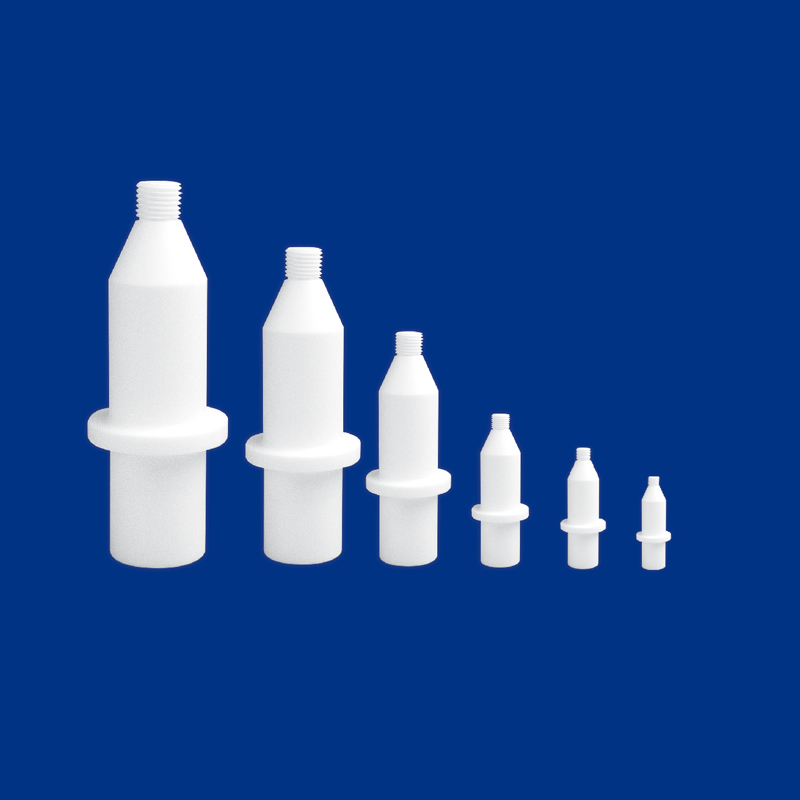



Gansu Juxiang Fluoroplastics Technology Co.,Ltd. manufactures PTFE insulation articles for electronic and electrical industries at production bases in Zhejiang and Gansu, and supplies them alongside a wider fluoroplastic range covering PTFE, PFA, FEP, PCTFE, PI and PEEK in sheet, rod, tube, film and machined-part form. The insulation articles are produced from PTFE granular resin by ram extrusion, then skived and machined to the drawing that defines the finished component.
These parts sit between a live conductor and the structure around it: insulator rods and bushings, cable and wire wrapping, connector bodies, stand-off sleeves, transformer and switchgear barriers, and the sleeving that protects cable runs on moving equipment. Material selection follows the working voltage, the temperature at the conductor, the mechanical load the article carries and the chemicals it meets in service.
- PTFE service temperature range of −180 °C to +260 °C
- Resistance to acids, bases, solvents and process fluids
- Low coefficient of friction where the article also guides or bears
- Low, stable dielectric constant and dissipation factor across the frequency band used in connector and cable work
- Non-wetting surface that resists moisture films and carbon deposit build-up
What the Insulation Range Covers
Insulation work in an electronic or electrical assembly rarely needs a single article. It needs a matched set: a rigid insulator where the conductor is supported, a thin film where space is tight, a heat-shrinkable sleeve where a joint has to be sealed, and a jacket where a cable run moves. We supply the fluoroplastic forms that cover those positions and machine them to the interface dimensions of the assembly.
| Product family | Form we supply | Where it fits in the assembly |
|---|---|---|
| PTFE insulation articles (ram extruded, skived) | Rods, tubes, sleeves, washers and bushings machined to drawing | Conductor support, stand-off insulation, bushing barriers |
| PTFE Film | Skived film in rolls and cut sheets | Slot liners, interlayer insulation, coil and capacitor wrap |
| PTFE Adhesive Tape | Film with pressure-sensitive adhesive backing | Wrap on busbars, coils and cable bundles where sleeving cannot be fitted |
| FEP, PFA Extrusion Tube | Extruded tube in natural and pigmented grades | Sleeving over wire and connector ferrules, chemical-resistant covers |
| FEP, PFA Heat-Shrinkable Tube | Expanded tube with a defined shrink ratio | Joint encapsulation, strain relief, connector sealing |
| PTFE insulation jacket pipe | Extruded jacket with machined ends | Thermal and electrical protection of cable and pipe runs |
| PTFE Dust-free Towing Chain Jacket | Jacket for cable carrier chains | Cable protection on semiconductor and automation equipment |
| PFA Rod, Tube | Extruded rod and tube | Machined insulators where a melt-processable resin is preferred |
| PCTFE, PI, PEEK Products | Rod, sheet and machined parts | Dimensional stability, high-strength or high-purity positions |
Ram Extrusion, Skiving and What the Process Gives You
PTFE does not flow like a conventional thermoplastic, so these articles are not injection moulded. Granular resin is preformed and ram extruded into a tube or rod, sintered, then skived on a machine to film or cut to length before finish machining. The result is a dense, oriented wall with consistent dielectric behaviour through its thickness.
Because the wall is formed rather than moulded, thickness and concentricity are set at the extrusion and machining stages. That matters electrically: an eccentric wall loads the thin side harder and shifts the field distribution around the conductor.
- Wall thickness and concentricity held to the drawing on the finished article
- Length, cut angle and end finish agreed per part number
- Skived film gauge selected to the winding or lining operation
- Sodium treatment of the surface where the article is bonded into a composite or potted assembly
Dielectric Verification: Power-Frequency Withstand and Partial Discharge
Our insulation articles are verified by a power-frequency voltage withstand test. The insulator is assembled with its conducting rod, immersed in oil and energised at 50 Hz, with partial discharge recorded alongside the withstand voltage. The results below come from that test on the N-series articles.
| Model No. | Withstand voltage (kV) | Partial discharge (pC) | Result |
|---|---|---|---|
| N1 | 29 | 0 | Pass |
| N2 | 30 | 3 | Pass |
| N3 | 30 | 0 | Pass |
| N4 | 32 | 2 | Pass |
| N5 | 28 | 0 | Pass |
| N6 | 30 | 0 | Pass |
Partial discharge is the more informative figure in service. An article that holds voltage but discharges continuously erodes from the inside, so the discharge reading is tracked together with the withstand level rather than after it.
Matching the Article to the Working Point
Electrical duty
Working voltage, frequency and the permitted discharge level define wall thickness and creepage distance. Where the article is a barrier between phases or to earth, the design also has to account for the field at the conductor radius and at any metallic insert.
Thermal and mechanical duty
PTFE and PFA hold properties to about 260 °C, FEP to roughly 200 °C, and PI is chosen where a thin section must survive higher temperature. PTFE creeps under sustained compressive load, so a clamped insulator needs a defined preload or a filled grade rather than virgin resin.
- Virgin PTFE for dielectric strength and chemical inertness
- Glass-fibre or other filled grades where stiffness and creep resistance dominate
- PCTFE where near-zero moisture absorption and dimensional stability are critical
- PI where thin-wall mechanical strength at elevated temperature is the constraint
Chemical and environmental exposure
Fluoropolymers resist most process fluids, but the surrounding hardware may not. Where an assembly is potted, bonded or overmoulded, we confirm the surface treatment and the adhesive system against the materials the article will contact.
Configuration Options We Machine To
Insulation articles are made to the drawing, not to a catalogue size. The variables below are the ones that change the part most often, and each is fixed before production starts.
- Outside and inside diameter, wall thickness, overall length and cut tolerance
- Concentricity and straightness for long rod and tube insulators
- Chamfers, radii, tapers, threads and relief grooves for assembly clearance
- Material grade: virgin, modified or filled PTFE, PFA, FEP, PCTFE, PI, PEEK
- Colour pigmentation for circuit or phase identification
- Surface treatment for bonding, potting or printing
- Unit packaging, tray presentation and clean-handling requirements for automated placement lines
Information We Use to Configure Your Solution
A workable proposal comes from the working point rather than a size alone. We align requirements one to one at the start of a project, review the material and then confirm the machining route across the Zhejiang and Gansu bases.
- Drawing or physical sample, with the dimensions that are functional and those that are reference
- Working voltage, frequency and the partial discharge limit the assembly must meet
- Conductor diameter and the mating hardware the insulator contacts
- Operating temperature range, including excursions during soldering, potting or curing
- Mechanical load, clamping force and vibration the article sees in service
- Chemicals, cleaning agents and sterilisation cycles in contact with the part
- Preferred material grade, filler content and any restriction on pigments or additives
- Annual quantity, call-off pattern and packaging format for your line
- Acceptance test scope and the documentation language required with the shipment
Quality Control, Documentation and Delivery Scope
Production parameters are monitored in real time from resin lot through extrusion, sintering and machining, and technical troubleshooting is handled during the run rather than after dispatch. Finished articles are inspected against the drawing and, where specified, submitted to the electrical test described above.
Shipments carry the documentation needed to release the parts into an assembly: dimensional records, material identification, test results where applicable, and handling guidance for storage and installation. Custom development and production run strictly to your drawings or samples, and our sales team handles the export formalities for the shipment.
- Incoming resin identification and lot traceability
- In-process checks on wall thickness, concentricity and length
- Final dimensional inspection against the approved drawing
- Power-frequency withstand and partial discharge testing on request
- Protective packaging agreed to the handling sensitivity of the article
Questions We Answer Before an Order
How do your insulation articles differ from standard PTFE tube?
Standard tube is supplied to a dimensional standard. Our PTFE Insulation Articles for Electronic and Electrical Industries manufacturer range is ram extruded from granular resin, skived and machined to the interface drawing, and verified by a power-frequency withstand test with partial discharge recorded, so the electrical result is attached to the part rather than assumed from the material data sheet.
Can you produce to our drawing instead of a catalogue size?
Yes. Customization is our core service, and we develop and produce fluoroplastic parts strictly to your drawings or samples. Send the drawing with the functional dimensions marked, and we return a configuration with material grade, machining route and inspection points defined.
Which material suits an insulator running continuously above 200 °C?
PTFE and PFA are the usual choices up to about 260 °C, with PTFE preferred where dielectric loss and chemical inertness dominate. FEP is limited to roughly 200 °C. Where a thin wall must also carry mechanical load at elevated temperature, PI or a filled PTFE grade is selected instead of virgin resin.
What test evidence accompanies an insulation article?
Dimensional records against the approved drawing are standard. On request, articles are submitted to the oil-immersed 50 Hz withstand test with partial discharge measurement, and the results are issued with the shipment together with material identification and handling guidance.