

 русский
 Deutsch
 عربى
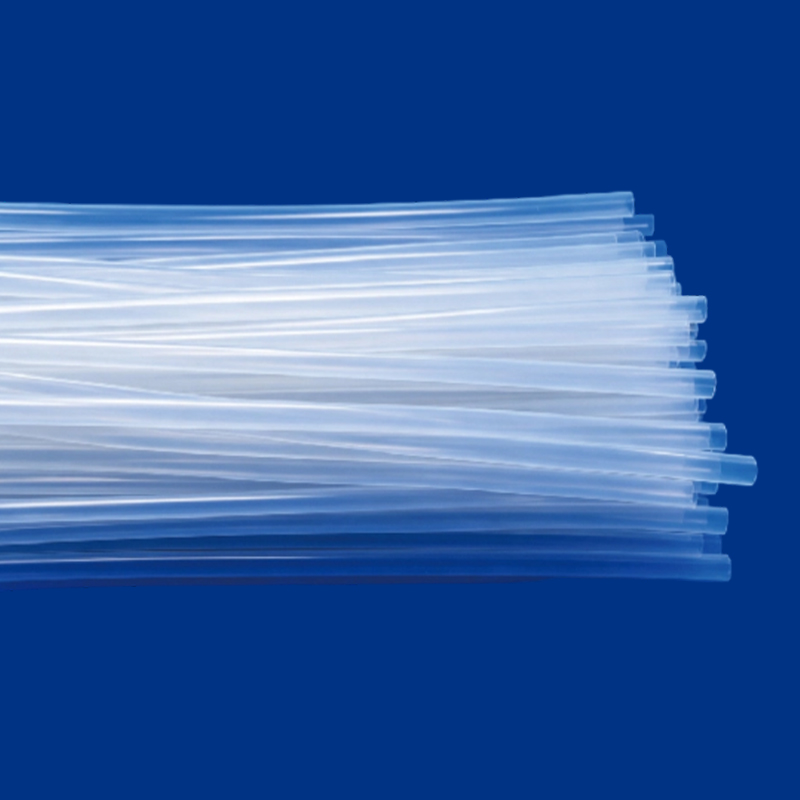



Gansu Juxiang Fluoroplastics Technology Co.,Ltd. is a fluoroplastic manufacturer in China producing FEP, PFA Heat-Shrinkable Tube for electrical insulation, fluid-line protection and anti-stick covering in semiconductor, chemical, aerospace and automation equipment. Two production bases in Zhejiang and Gansu carry the range from PTFE, PFA, FEP, PCTFE, PEEK, PI and PVDF resins through to extruded tube, film, sheet and machined sealing components.
Heat-shrinkable tubing leaves our works in an oriented, expanded state and recovers to its manufactured dimensions when heated, closing down onto the component beneath it. FEP and PFA are melt-processable fluoropolymers, so the tube can be continuously extruded and expanded to a controlled ratio, producing a tight, void-free cover without the sintering route that PTFE requires.
What the FEP and PFA Heat-Shrinkable Tube Range Covers
As a FEP, PFA Heat-Shrinkable Tube manufacturer, we supply the tubing in clear FEP and clear PFA grades, in cut lengths or spooled form, with recovered diameter, wall thickness and length set against the part it has to cover.
- FEP heat-shrinkable tube — transparent cover for splices, connector back-ends, sensor leads and thermocouple junctions where the joint must stay visible after recovery.
- PFA heat-shrinkable tube — the higher-temperature option for wet-bench fluid lines, high-purity transfer tubing and components that see repeated thermal cycling.
- Related extruded and machined forms — unshrunk FEP, PFA Extrusion Tube and PFA Rod, Tube for assemblies that combine a shrinkable cover with a permanent liner or a machined end fitting.
- Equipment-level protection — where tubing protects moving cables rather than a fixed joint, the PTFE Dust-free Towing Chain Jacket covers the same duty in drag-chain service.
FEP or PFA — Matching the Polymer to the Working Point
Both polymers are fully fluorinated and behave similarly against chemicals and electrical stress. The choice is normally decided by the continuous temperature at the substrate and by how much release and purity the application demands.
| Selection factor | FEP heat-shrinkable tube | PFA heat-shrinkable tube |
|---|---|---|
| Polymer | TFE/HFP copolymer, melt-processable | TFE/perfluoroalkyl vinyl ether copolymer, melt-processable |
| Service temperature | -200 °C to +200 °C | -200 °C to +260 °C |
| Chemical resistance | Inert to most acids, bases, solvents and oils; elemental fluorine and molten alkali metals at elevated temperature are the recognised exceptions | Same resistance profile, with more margin where the line runs hot |
| Dielectric behaviour | Dielectric constant about 2.1 from 60 Hz to 60 MHz; volume resistance above 1018 Ω, surface resistance above 1013 Ω, arc resistance above 165 s | Comparable dielectric constant and resistivity |
| Release and friction | Coefficient of friction 0.2–0.3, contact angle around 114° | Same non-stick character, retained to a higher temperature |
| Optical result | Transparent; joints remain inspectable after recovery | Transparent to slightly hazy depending on wall |
| Typical fit | Cable harness, connector boots, roll covering, general electrical insulation | Semiconductor wet process, high-purity fluid lines, hot chemical service |
Combustion behaviour is favourable for both grades: the tubing does not sustain a flame in air and the oxygen index is high, which is why it is used where a fluoropolymer cover has to sit close to heat sources.
Where the Tubing Fits in Process and Equipment
- Semiconductor and high-purity lines — covering PFA fluid connections, sealing the transition between tubing and fittings, and protecting sensor leads inside wet benches and cleaning tools.
- Cable and harness protection — splice insulation, abrasion protection at cabinet entries and strain relief at connector backshells, including aerospace and rail harness work.
- Chemical and analytical equipment — pump and valve leads, dosing lines and instrument wiring exposed to acid mist or solvent splash.
- Anti-stick covering — recovered PFA over rollers, guide bars and chute surfaces where toner, resin or adhesive must release cleanly.
- Thermal and electrical separation — a thin fluoropolymer wall between a hot component and adjacent wiring, or between a live conductor and a metal housing.
Configuration Variables We Agree Before Production
Recovered dimensions are the controlling specification. The expansion ratio applied during orientation is set to reach them without over-stressing the substrate, and the as-supplied diameter follows from that ratio.
- Recovered inner diameter and the substrate diameter it must grip, including tolerance on both.
- Wall thickness after recovery, and whether the wall must stay concentric on an offset or bent substrate.
- As-supplied inner diameter, so the tube can be slipped over the component without forcing it.
- Cut length, cut tolerance and end condition — square cut, deburred or chamfered for automated feeding.
- Delivery format: loose cut pieces, sorted and bagged, or continuous spool for inline shrinking equipment.
- Colour and opacity, where identification or UV screening is required.
Installation, Recovery and Operator Safety
Recovery happens above the polymer's softening range, and the set point depends on wall thickness, substrate mass and the heat source used. A controlled hot-air tool with a spreader works for single assemblies; a conveyor oven suits volume production where every part sees the same time and temperature.
- Heat from one end and work along the tube so trapped air escapes ahead of the shrinking wall.
- Keep direct flame off the tubing; local overheating degrades the surface and produces acidic decomposition products that need extraction.
- Check that the substrate tolerates the recovery temperature before the first assembly, particularly on PVC-insulated cable and low-temperature elastomer seals.
- Deburr metal edges and remove sharp flash; a thin recovered wall can be cut through by a burr under compression.
- Allow the part to cool before handling or testing so the recovered dimensions stabilise.
Quality Control, Documentation and Acceptance
Inspection items are fixed with you at quotation stage and repeated on each batch, so acceptance at goods-in follows the same criteria used at our works. Dimensional checks cover as-supplied inner diameter, wall thickness and cut length, and a recovery trial confirms the shrunk diameter on a sample from the lot.
- Visual inspection for bubbles, gels, die lines, contamination and colour variation against an agreed limit sample.
- Resin grade and lot recorded against the production batch for traceability.
- Recovery trial on a customer-supplied substrate where the fit is critical, with the measured result reported.
- Clean-room bagging and double packing for semiconductor and medical accounts.
- First-article samples submitted for approval before series production on new tooling or new dimensions.
Information We Use to Configure Your Solution
A workable quotation needs the working point, not only a diameter. The matrix below shows what each input changes in the proposal.
| Project input | Why it matters | What it determines |
|---|---|---|
| Substrate diameter, material and surface condition | Sets the grip and the risk of cutting a thin wall | Recovered inner diameter and minimum wall |
| Continuous and peak temperature | Decides whether FEP or PFA is viable | Polymer grade and wall thickness |
| Chemical exposure and cleaning cycles | Affects long-term surface integrity | Grade selection and surface finish |
| Electrical duty — voltage, frequency, insulation path | Defines dielectric margin | Wall thickness and overlap length |
| Assembly method and heat source | Controls how much the tube must expand to fit | As-supplied diameter and recovery ratio |
| Annual quantity and feeding method | Drives cut length tolerance and packing | Spool or cut supply, bagging, labelling |
| Drawing, standard or sample part | Anchors the dimensional agreement | Inspection plan and acceptance criteria |
Questions We Answer Most Often
For a 200 °C application, is FEP or PFA the better choice?
FEP is rated to +200 °C and is normally sufficient when the continuous temperature stays at or below that figure with margin for peaks. Where the part sees sustained heat near the limit, repeated thermal cycling, or hot chemical contact, PFA at +260 °C gives the safer working margin. We review the actual temperature profile rather than the nominal line rating before recommending a grade.
Can you supply cut lengths to a recovered diameter instead of a shrink ratio?
Yes. We work from the recovered inner diameter and wall thickness you need, then set the expansion ratio and as-supplied diameter to suit your assembly method. Cut length, tolerance and end condition are agreed on the drawing, and a recovery trial on your substrate confirms the fit before the batch runs.
How do we install the tubing without damaging the component underneath?
Use a controlled hot-air tool or a conveyor oven, heat progressively from one end, and keep flame away from the tube. Confirm first that the substrate tolerates the recovery temperature, remove burrs from metal parts, and let the assembly cool before handling. For volume work we can advise on tooling geometry and dwell time so every part recovers identically.
What accompanies a shipment?
Each batch ships with the agreed inspection record, resin grade and lot reference, and packing that matches the cleanliness level of the application. Where a project requires a recovery trial or first-article report, that result is issued with the approval samples and referenced in the delivery documents.