

 русский
 Deutsch
 عربى
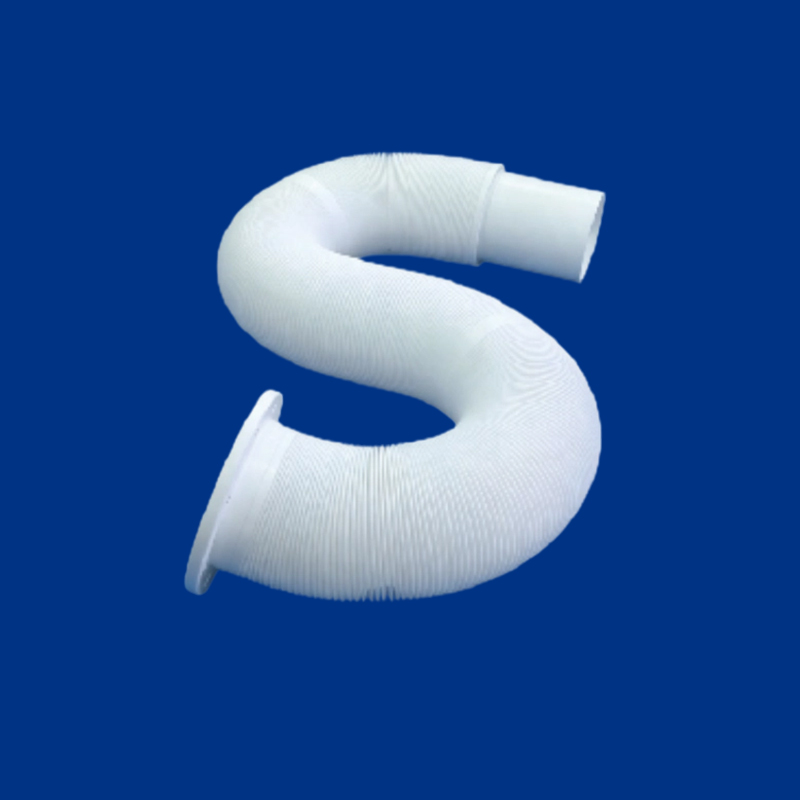


Corrugated PTFE Tubing from a Dedicated Fluoroplastic Manufacturer
Gansu Juxiang Fluoroplastics Technology Co.,Ltd. is a PTFE Corrugated Tube manufacturer supplying convoluted polytetrafluoroethylene tubing and tube assemblies to chemical, laboratory, semiconductor, pharmaceutical and aerospace equipment builders. We are a joint venture of Zhejiang Jiaxiang Fluoroplastics Co., Ltd. and Gansu Juhua New Materials Co., Ltd. of the Juhua Group, producing in Yumen City, Gansu Province alongside our Zhejiang base.
Corrugated PTFE tube starts as PTFE dispersion resin compounded with additive, high-pressure extruded and sintered, then formed into a convoluted wall. The convolution keeps the chemical inertness, non-stick surface and electrical insulation of PTFE while adding flexibility, a short bend radius and the capacity to absorb vibration, thermal movement and minor misalignment in otherwise rigid runs.
- Convoluted tube in transparent and opaque PTFE, in bore sizes matched to the customer's connection and flow requirement
- Tube assemblies with CNC-machined PTFE connectors, including quick-link style couplings for small-bore laboratory and instrument lines
- Straight extruded PTFE tube, rod and skived sheet from the same material family for the rigid sections of a mixed run
- Complementary fluid-handling items: sealing tape, gaskets, piston and guide rings, and PFA/FEP smooth-bore tubing
Where Corrugated PTFE Tube Fits
The corrugated wall is the reason this tube is specified where a straight PTFE tube would transmit load into a fitting or crack at a bend. Each convolution acts as a small compliant element, so the assembly tolerates movement between two fixed points without adding elbows, swivels or expansion loops.
- Chemical and petrochemical transfer: reagent feed, sampling and vent lines carrying acids, alkalis and solvents where wetted-part inertness is the governing requirement
- Laboratory and analytical equipment: small-bore flexible connections between glassware, pumps, manifolds and instruments, frequently with machined PTFE quick-link connectors
- Semiconductor and electronics wet processing: high-purity fluid paths and equipment-side connections where extractables and particle shedding must stay controlled
- Pharmaceutical and medical equipment: non-toxic, non-stick fluid delivery where cleaning and product release matter
- Aviation, automotive and automation: vibration isolation, thermal expansion compensation and light-duty protection in confined equipment envelopes
Service temperature for PTFE parts of this type spans roughly -180 °C to +260 °C. Pressure capability is not a single figure: it falls as bore, temperature and convolution depth increase, and it depends on how the tube is restrained at each end. We confirm the working point rather than quoting a headline rating.
Configuration Variables That Define the Tube
Every corrugated tube we quote is built around a defined working point. The matrix below shows the variables we resolve with the customer before production, and why each one changes the part.
| Variable | What we confirm | Effect on the finished tube |
|---|---|---|
| Bore (ID) | Nominal inside diameter and tolerance, matched to the connector or hose barb | Sets flow area and the pressure the wall can carry |
| Wall and outside diameter | Wall thickness and OD over the crest of the convolution | Balances flexibility against burst and collapse resistance |
| Convolution geometry | Pitch, depth and profile of the corrugation | Determines bend radius, compression and extension travel |
| Length and cut | Free length, cut squareness, allowance for installed extension | Prevents the tube pulling on fittings in service |
| Resin and appearance | PTFE dispersion grade, additive package, transparent or opaque finish | Affects purity, colour control and visual inspection criteria |
| End connections | Machined PTFE quick-link connectors, flanges, threaded adaptors or plain ends | Defines assembly method and leak path |
| Duty | Medium, concentration, continuous temperature, pressure and cycling | Sets the acceptance test and the safe operating envelope |
| Cleanliness and packing | Cleaning level, individual bagging, labelling, bulk or kit packing | Protects the bore between our factory and the point of installation |
End Connections and Line Integration
A corrugated tube is only as good as its termination. We machine PTFE connectors from PTFE blank on CNC equipment, which lets us hold the bore and sealing face that the tube actually needs rather than forcing the assembly onto a catalogue fitting. Quick-link connectors are the usual choice for small-bore laboratory and instrument work; flanged and threaded variants suit larger process connections.
- Connector drawings or samples are matched to the tube bore, wall and convolution start point
- Assemblies can combine corrugated sections with smooth-bore FEP and PFA extrusion tube where a straight, low-permeability run is preferred
- Thermal and mechanical protection is available through PTFE insulation jacket pipe and dust-free drag-chain jacketing for moving cable and hose runs
- Installation guidance covers minimum bend radius, support spacing, axial travel allowance and fitting torque
Because the tube is flexible, the routing on site rarely matches the drawing exactly. We size the free length with that in mind and state the installed extension and compression limits so the line can be set without over-stressing the convolutions.
Quality Control, Documentation and Delivery Scope
Production runs through our own extrusion, sintering, forming and machining steps, which keeps material identity and dimensional control inside one chain. Inspection follows the drawing: bore, wall, convolution pitch, overall length, cut quality and connector fit are checked before packing, and assemblies are pressure- or leak-checked against the agreed test condition.
- Dimensional inspection records and material documentation issued with the shipment
- Visual acceptance criteria agreed at quotation stage for transparent and opaque tube, including colour and surface condition
- Sample or first-article approval before volume production on new configurations
- Individual bagging, protective capping of connector ends and labelled cartons for export handling
- Usage guidance and technical follow-up after delivery, with inquiries answered within 12 working hours
Customization is our core service: we develop and produce fluoroplastic parts strictly to customer drawings or samples, and the same approach applies to corrugated tube, connector assemblies and the sealing and insulation items that surround them in a fluid system. The wider fluoroplastic product range covers PTFE, PFA, FEP, PCTFE, PEEK, PI and PVDF in sheet, rod, tube and machined form.
Information We Use to Configure Your Solution
A usable quotation for corrugated PTFE tube depends on a small set of inputs. When these are on the table, we can propose bore, wall, convolution geometry, connector type and test regime in one pass instead of trading preliminary drawings.
- Drawing or sample, or at minimum the required bore, outside diameter and free length
- Medium, concentration and whether the line is continuous or intermittent
- Continuous operating temperature and any steam, CIP or sterilisation cycle
- Working pressure, vacuum condition and pressure or flex cycling expected in service
- Connection details: mating thread, flange standard, quick-link size or hose barb
- Routing constraints: minimum bend radius, available space, movement between anchor points
- Cleanliness, transparency and colour requirements, plus any documentation package
- Annual quantity, batch size, spare-part split and packaging or labelling instructions
Send the working point and the connection interface, and we will return a configuration with the tube dimensions, connector specification, acceptance test and delivery scope defined.
Frequently Asked Questions
What temperature range does your corrugated PTFE tube work in?
PTFE parts of this type operate from approximately -180 °C to +260 °C. The practical limit for a given assembly is set by the pressure at temperature and by the end connections, so we confirm the continuous operating temperature together with the pressure when the tube is configured.
Can you supply complete assemblies with connectors fitted?
Yes. We machine PTFE connectors from PTFE blank on CNC equipment and fit them to the corrugated tube to the supplied drawing, including quick-link connectors for small-bore laboratory and instrument lines. Assemblies are leak-checked against the agreed test condition before packing.
How does corrugated PTFE tube differ from straight extruded PTFE tube?
The material is the same; the wall form is different. The convolution gives a much shorter bend radius, axial compliance and vibration absorption, which suits connections between fixed equipment. Straight extruded tube carries higher pressure for the same wall and is the better choice for long, rigid runs, so mixed systems often use both.
What do you need from us to quote a custom corrugated tube?
A drawing or sample is ideal. Otherwise send bore, outside diameter, free length, medium, temperature, pressure, connection type and annual quantity. With those inputs we define the convolution geometry, connector specification, acceptance test and packaging, and return a configuration and quotation.