

 русский
 Deutsch
 عربى


Fluoroplastic Tube, Connector and Valve Components for Small-Bore Fluid Systems
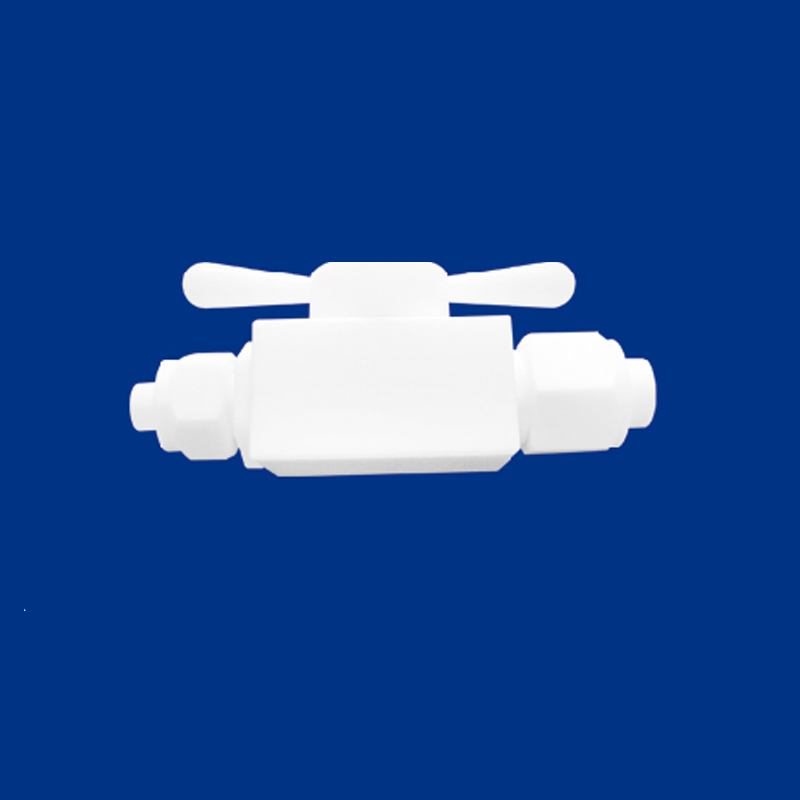
Gansu Juxiang Fluoroplastics Technology Co.,Ltd. is a fluoroplastic manufacturer in China with production bases in Zhejiang and Gansu. As a PTFE Tube, Connector, Valve manufacturer, we supply small-bore PTFE tubing, CNC-machined quick-link connectors and valve sealing components for laboratory equipment, analytical instruments, chemical transfer lines and semiconductor wet-process hardware.
The range is positioned for assemblies that need inert wetted surfaces, low friction and repeatable fit in a compact envelope. Parts are produced to drawing or sample, with material grade, dimensions and connection interface agreed before production.
- PTFE tube in straight lengths or coils, with bore and wall selected for flow and bend radius.
- Quick-link connectors machined from PTFE blank for small-diameter tube joining.
- Valve seats, stems, diaphragms and gaskets for shut-off and control duties.
- PFA and FEP alternatives where melt-processable tubing or a smoother bore is required.
Because seals, gaskets and tube components are machined in the same plants, connectors and valve parts can be supplied with matching PTFE thread seal tape and joint hardware from one order, reducing mixed-material risk at the connection.
Product Range and Application Fit
Each family covers a different part of the fluid path. The table shows how we position the main product types and what we confirm during configuration.
| Product family | Typical role | Material options | Configuration points |
|---|---|---|---|
| PTFE tube | Chemical transfer, sample lines, insulation sleeves | Virgin PTFE, filled PTFE | OD, ID, wall, tolerance, coil or straight length |
| Quick-link connectors | Small-bore tube joining in lab and instrument assemblies | PTFE, PFA | Bore, tube OD, latch or ferrule style, panel mount |
| Valve seats and stem seals | Shut-off valves, diaphragm valves, lined valve bodies | Virgin PTFE, modified PTFE, filled PTFE | Seat angle, stem diameter, stroke, compression allowance |
| PFA and FEP tube | High-purity lines, sight lines, continuous runs | PFA, FEP | OD, ID, wall, flare or compression fitting |
| Joint sealing accessories | Threaded ports and flange make-up | PTFE, expanded PTFE | Width, thickness, density, gasket ID and OD |
For high-purity or elevated-temperature lines, PFA rod and tube is often specified alongside PTFE connectors so that the wetted path stays consistent from tube to fitting.
Material Selection: Virgin PTFE, Filled PTFE and Melt-Processable Grades
PTFE is the default for chemical inertness and low friction, but the grade determines creep resistance, wear life and dimensional stability under load. We match the compound to the duty rather than treating PTFE as a single material.
- Virgin PTFE — maximum chemical resistance and purity for laboratory and high-purity lines, with lower load-bearing capacity.
- Filled PTFE — glass, carbon, graphite or bronze additions raise compressive strength and wear resistance for seats, guides and pistons.
- Modified PTFE — denser structure and lower permeability for sealing frames and large gaskets.
- PFA and FEP — melt-processable grades with a smooth bore and higher transparency where tube inspection matters.
Wall thickness, concentricity and ovality are as important as resin choice in small-bore tube. A tube that meets nominal bore but distorts at the connector interface will leak regardless of material grade, so we review the joint as a system. Filled grades are drawn from our filled PTFE tube and rod range when wear or creep governs the design.
Critical Specifications and Configuration Options
We build the quotation from the working point, not from a nominal size alone. These inputs change the part design, machining route and inspection plan.
| Parameter | What we confirm | Effect on the part |
|---|---|---|
| Tube size | OD, ID, wall thickness, tolerance, length or coil | Flow area, bend radius, connector fit |
| Connection interface | Quick-link, compression, threaded NPT, BSP or metric, flange | Body geometry, hex size, seal method |
| Media | Acid, solvent, high-purity water, gas, slurry | Resin grade, filler, surface finish |
| Temperature | Continuous and peak operating temperature | Material choice, creep allowance, clearance |
| Pressure | Working and test pressure, cyclic or static duty | Wall thickness, seat compression, support |
| Valve function | On/off, throttling, diaphragm, lined body | Seat angle, stem seal, actuation interface |
| Cleanliness | Degreasing, bagging, cleanroom packing | Handling route, final wash, packaging |
| Quantity | Prototype, pilot batch, serial supply | Machining method, fixture design, lot traceability |
Machining, Inspection and Documentation
Quick-link connectors are machined from PTFE blank on CNC equipment, which holds bore, latch geometry and tube stop in one setup. Tubes are extruded or machined depending on wall thickness and tolerance. Production parameters are monitored through the run, and finished parts are checked against the drawing before packing.
We agree the documentation package at quotation. It typically covers material identification, dimensional records for the characteristics marked on the drawing, and handling guidance for installation and storage. Where a project requires certification evidence, the applicable documents are confirmed with the order.
Integration Support and Project Coordination
Our engineering team works from the customer's drawing, sample or operating description. Material matching, fixture optimization and process analysis are handled in-house, with production scheduled across the Zhejiang and Gansu bases according to capacity and delivery requirement. Enquiries receive a technical reply within 12 working hours.
- Drawing review and tolerance feedback before quotation.
- Material grade recommendation against the media and temperature list.
- First-article samples for fit checks on connectors and valve seats.
- Packaging and labeling aligned to incoming inspection.
Information We Use to Configure Your Solution
A complete enquiry shortens the path from drawing to production. These inputs let us quote a workable part rather than a nominal size.
- Application and equipment type, with the location in the fluid path.
- Media, concentration, temperature and pressure, including cleaning cycles.
- Tube OD, ID, wall, length and allowable tolerance.
- Connector type, thread standard, panel-mount or bulkhead requirement.
- Valve function, actuation and available stroke or mounting envelope.
- Drawing, 3D model or physical sample with critical dimensions marked.
- Annual quantity, batch size and delivery schedule.
- Cleaning, bagging and labeling requirements.
Frequently Asked Questions
Are the quick-link connectors machined or molded?
They are CNC-machined from PTFE blank, which gives control over bore, tube stop and latch geometry in small sizes. Tubes are extruded or machined depending on wall and tolerance, and we confirm the process route at quotation.
Can you produce to our drawing or a physical sample?
Yes. Customization is our core service, and we develop parts to the customer's drawing or sample. Send the model or sample with media, temperature, pressure and connection standard so the material grade and tolerances can be fixed.
Which PTFE grade should be used for a valve seat?
Virgin PTFE suits chemical inertness and low friction. Filled PTFE with glass, carbon or graphite is used where compressive load, wear or creep demands more stiffness. Seat angle, stem diameter and stroke set the compression allowance, so the grade is selected against those values.
How do you handle tube-to-connector compatibility?
We confirm tube OD, wall tolerance and ovality against the connector grip range before production. For small-bore laboratory lines the quick-link connector is normally the simplest interface; threaded and flanged adapters are used where the assembly needs a fixed port.