

 русский
 Deutsch
 عربى
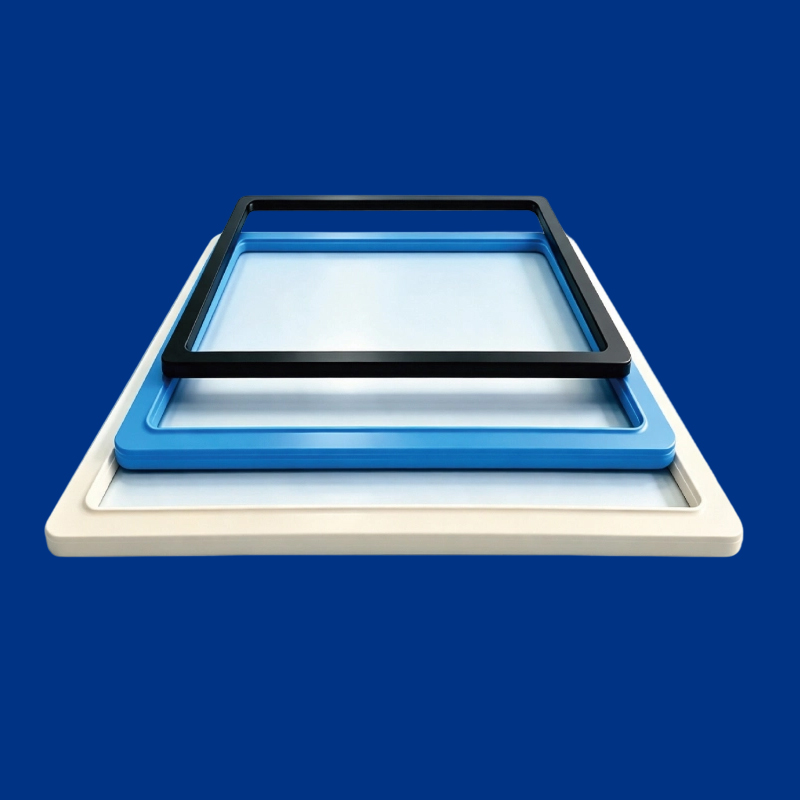



Gansu Juxiang Fluoroplastics Technology Co.,Ltd. manufactures large integrated molded PTFE sealing frames and gaskets as single-piece sintered and machined components, not as sheet stock cut, spliced or welded into a ring. The range serves equipment where the seal is too large, too irregular or too critical for a fabricated joint: electrolytic cells, chemical storage tank flanges, hydrogen fuel cell stacks, and large non-standard frames for etching and cleaning equipment.
We mold and sinter the PTFE blank as one continuous mass, then finish the geometry by CNC milling. Circular gaskets are produced up to 4000 mm in diameter; rectangular and square sealing frames up to 4000 mm total outer length; irregular formats are machined to drawing within the same working envelope. The company is a joint venture of Zhejiang Jiaxiang Fluoroplastics Co., Ltd. and Gansu Juhua New Materials Co., Ltd., with production in Yumen, Gansu and in Zhejiang, and a fluoroplastic portfolio that also covers PFA, FEP, PCTFE, PEEK, PI and PVDF.
- No joint anywhere in the seal: no weld bead, no splice step, no seam to open under compression or thermal cycling.
- Large-format capability: monolithic rings and frames beyond the practical limit of sheet-based fabrication.
- Machined features: bolt holes, grooves, steps, chamfers and profiled sealing faces cut after sintering.
- Fluoroplastic duty: acid and alkali resistance, high-temperature tolerance and stable sealing force in aggressive service.
One-Piece Molding Instead of Cut-and-Welded Sheet
Conventional large PTFE seals are assembled from skived or molded sheet, cut into segments and welded or spliced into a ring. Every one of those joints is a discontinuity: density differs from the parent material, the weld line sits at a different strength level, and the splice thickness creates a local high spot that disturbs load distribution across the flange. On a cell cover or a tank mouth, that is where leakage starts.
Our process removes the joint entirely. Resin is charged into a mold sized for the finished frame, consolidated and sintered as a single body, then machined to the drawing. Density and mechanical behaviour are consistent around the full perimeter, and the sealing faces are flat and parallel across the whole contact area rather than only within individual segments.
- Uniform structural integrity from one end of the frame to the other.
- Smooth, flat sealing surfaces that seat against the flange without splice-induced gaps.
- No welded zone to crack, embrittle or creep differently from the surrounding material.
- Geometry freedom: non-circular outlines, asymmetric bolt patterns and internal cut-outs are machined, not assembled.
Product Range and Size Envelope
The Large integrated molded PTFE sealing frame and gasket manufacturer range is organised by geometry rather than by resin grade, because the geometry is what determines whether an integrated molded part is the right answer at all.
| Product form | Typical configuration | Working envelope | Application fit |
|---|---|---|---|
| Circular sealing ring | Monolithic ring, flat or stepped face, drilled bolt circle | Outside diameter up to 4000 mm | Tank and vessel flanges, electrolytic cell covers, large pipe connections |
| Rectangular / square sealing frame | Closed frame with machined inner opening and bolt pattern | Total outer length up to 4000 mm | Cell frames, chamber and cabinet doors, stack plates, trough covers |
| Irregular and non-standard frame | Asymmetric outline, multiple openings, profiled section | Machined to drawing within the same envelope | Etching and cleaning equipment, special anti-corrosion sealing duties |
| Thick-section and grooved frame | Machined groove, step, chamfer or locating feature | Built to drawing | Positions where a flat cut gasket cannot hold compression or stay located |
| Companion sealing products | Modified PTFE Gasket, Expanded PTFE Reinforced Flange Gasket, Filled PTFE Product | Standard and intermediate sizes | Smaller flanges, standard pipework, duties needing higher creep resistance |
Where Large Molded Frames Fit
The applications below share one condition: the sealing perimeter is long enough, or the shape irregular enough, that a fabricated ring introduces risk the process cannot tolerate.
- Chlor-alkali and electrochemistry. Large sealing frames for electrolytic cells and tank sealing gaskets, where caustic and chlorine exposure combine with elevated temperature and long service intervals.
- Electronic chemicals. Corrosion-resistant flange gaskets for liquid storage tanks handling acids, solvents and high-purity chemical streams.
- New energy. Sealing gaskets for hydrogen fuel cell stacks, where frame flatness and consistent compression directly affect stack efficiency.
- Semiconductor equipment. Large non-standard sealing frames for etching machines and cleaning tools, machined to the tool builder's drawing.
- General anti-corrosion sealing. Oversized, irregularly shaped and non-standard equipment where no standard gasket size applies.
Material Selection and Critical Specifications
Integrated molding solves the joint problem; the resin decision solves the service-life problem. Virgin PTFE gives the broadest chemical resistance and the lowest friction, but it creeps under sustained bolt load. Where the flange is heavily loaded, cycled thermally, or the medium attacks standard compounds, we discuss modified PTFE and filled grades so that compression set and dimensional stability under load are matched to the duty rather than assumed.
These are the values that define a workable frame, and the ones we machine against:
- Inside and outside dimensions, frame width, and the full outline for non-circular parts.
- Thickness with tolerance, and thickness variation permitted across the sealing face.
- Flatness and parallelism of the two sealing faces, measured over the full perimeter.
- Bolt hole diameter, pitch, count and position relative to the sealing centreline.
- Grooves, steps, chamfers, radii and any locating feature, with tolerances.
- Surface condition of the sealing face, including whether a machined finish is acceptable.
- Operating temperature range, medium and concentration, and continuous versus cyclic duty.
- Available bolt load and target compression, plus any flange flatness limit on the equipment side.
Machining, Inspection and Acceptance
Machining is where a molded blank becomes a sealing component. We cut the sealing faces, the inner opening and the bolt pattern in sequence from the same set-up reference, so hole positions and the sealing centreline stay related to each other. Inspection points are agreed with you before release, and the dimensional record is issued against the approved drawing.
- Dimensional verification of outline, opening, thickness and hole pattern.
- Flatness check on both sealing faces across the full frame.
- Visual inspection for voids, contamination, machining marks and edge damage.
- Part marking and packing arranged so the sealing faces are protected in transit.
- Documentation package and handling guidance supplied with the shipment.
Installation and Long-Term Sealing Performance
A large molded frame performs only if it is treated as a precision part during installation. Support the frame across its full area while lifting; do not let a 3-metre ring hang from two bolt holes. Confirm the mating flange is clean and flat before positioning, and bring the bolts up in a cross pattern in several passes so compression develops evenly around the perimeter.
- No additional sealant or grease on the sealing faces unless the medium requires it.
- Store frames flat on a clean surface, out of direct sunlight, before installation.
- Re-check bolt torque after the first thermal cycle on high-temperature service.
- Inspect and replace at planned shutdowns where creep or chemical attack is expected.
Information We Use to Configure Your Solution
A quotation for a large integrated frame is only as good as the drawing and duty data behind it. Send the following and we can confirm geometry, resin grade and machining route in one pass:
- Dimensioned drawing or a dimensioned sketch with tolerances; a sample part where no drawing exists.
- Equipment type and where the seal sits in the assembly.
- Medium, concentration and phase, plus any cleaning or sterilisation chemicals.
- Operating and peak temperature, pressure, and whether the duty is static or cycled.
- Flange or groove dimensions, bolt size and available bolt load.
- Quantity per order, annual requirement and delivery schedule.
- Required documentation, marking and packing format.
Frequently Asked Questions
Can you produce a PTFE gasket larger than a standard sheet?
Yes. Because the part is molded and sintered as one body rather than cut from sheet, the size limit is set by our tooling and machining envelope, not by sheet dimensions. We produce circular gaskets up to 4000 mm in diameter and rectangular or square frames with a total outer length of up to 4000 mm, plus irregular frames machined to drawing within that envelope.
Why is a welded PTFE ring a weaker solution than an integrated molded frame?
A welded or spliced ring carries a joint around its perimeter. That joint has different density and strength from the parent material, it creates a local thickness step under compression, and it is the first place leakage or cracking appears under thermal cycling. An integrated molded frame has no joint, so load distribution and sealing behaviour are consistent around the whole perimeter.
Do you machine bolt holes, grooves and steps into the frame?
Yes. After sintering, the blank is CNC milled to final geometry, including the inner opening, bolt pattern, grooves, steps, chamfers and profiled sealing faces. Features are machined from a common reference so the bolt pattern and sealing centreline remain correctly related.
What do you need to quote a large sealing frame?
A dimensioned drawing with tolerances, the medium and operating temperature, the flange or groove dimensions and available bolt load, the quantity and required delivery schedule, and any documentation or marking requirements. With those we confirm the resin grade, the machining route and the inspection points, and return a configuration and price for the specific part.