

 русский
 Deutsch
 عربى
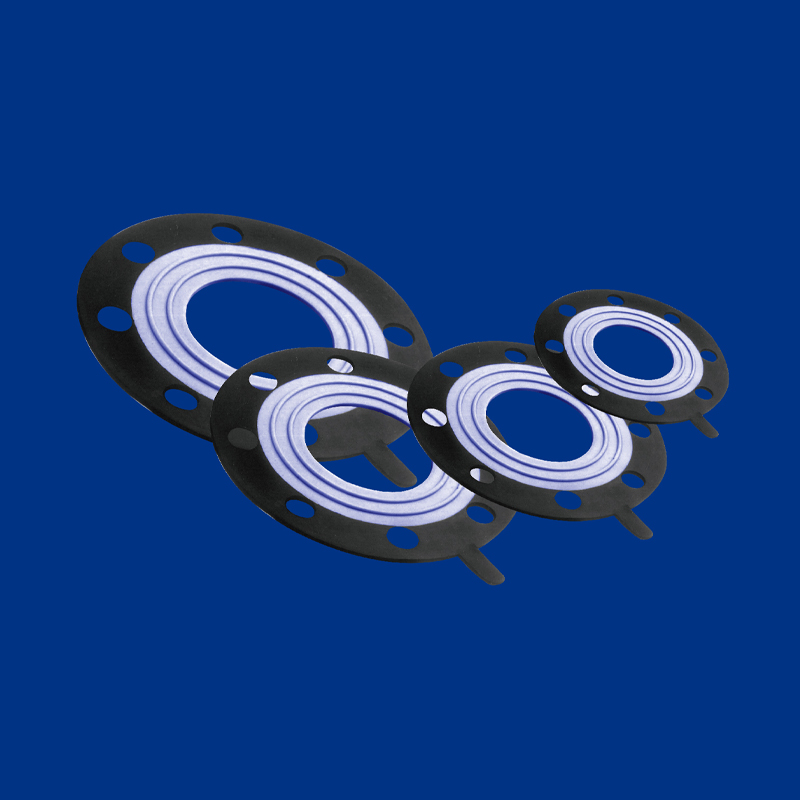



Gansu Juxiang Fluoroplastics Technology Co.,Ltd. manufactures PTFE elastomer gaskets in Yumen City, Gansu Province, from a joint-venture base backed by Zhejiang Jiaxiang Fluoroplastics and Juhua Group. The product is a composite soft gasket: a PTFE facing carries the corrosion and cleanliness duty, while an elastomer core of EPDM, FKM or NBR provides compression and recovery. We supply the JXF6018E/F series and cut gaskets to flange drawings for chemical, pharmaceutical, food-processing and water-handling equipment.
We are a PTFE Elastomer Gasket manufacturer in China serving project teams that need a clean, corrosion-resistant seal without a stainless steel wetted flange. The range covers flat and raised face flanges from 0.6 MPa to 2.0 MPa and 0 °C to 150 °C, with the PTFE surface protecting the process side and the elastomer core reducing the bolt preload needed to seat the joint.
Product Range and Positioning
Three constructions make up the standard supply scope. Each pairs a PTFE coating with a different elastomer, so the choice follows the media list, the flange facing and the assembly method rather than a single default.
- EPDM + PTFE — polar media, water, steam, acids and alkalis; not for hydrocarbon oils and fuels.
- FKM + PTFE — oils, fuels, hydrocarbons and many acids; limited by ketones, amines and hot water or steam.
- NBR + PTFE — oils, fuels, water and general industrial service; limited by strong acids, ketones and ozone.
- Cut-to-drawing geometry — rings and non-standard outlines produced to flange drawings or samples.
- JXF6018E/F — the catalogued PTFE elastomer gasket grade with the published index values shown below.
| Construction | Elastomer core | PTFE facing role | Typical application fit |
|---|---|---|---|
| EPDM + PTFE | Ethylene propylene diene rubber | Corrosion barrier against the process fluid | Water, steam, acids, alkalis and polar media in chemical and food service |
| FKM + PTFE | Fluorocarbon rubber | Chemical barrier with a higher-temperature elastomer core | Oils, fuels, hydrocarbons and many acid streams |
| NBR + PTFE | Nitrile butadiene rubber | Clean wetted surface over a general-purpose resilient core | Oils, fuels, water and general industrial flanges |
The PTFE facing is the wetted barrier, not a release coating. Its condition at the cut edge and around the bolt holes is part of the dimensional and visual acceptance, because that is where a soft composite gasket is most easily damaged before installation.
Related Sealing Products in the Same Range
Where the duty moves beyond an elastomer core, we supply adjacent sealing products from the same fluoroplastic range.
- Modified PTFE Gasket — all-PTFE sealing where an elastomer core is not suitable for the media or temperature.
- Expanded PTFE Reinforced Flange Gasket — reinforced construction for steel flanges and bolted joints that need greater dimensional stability.
- Rubber O-ring — groove sealing for valves, pumps and housings in the same process systems.
Application Fit: Flanges, Media and Cleanliness
PTFE elastomer gaskets are specified for flat and raised face flange sealing surfaces. The published service window is 0.6–2.0 MPa and 0–150 °C for corrosive media or media with high cleanliness requirements, including acids, alkalis, halogens, food and pharmaceutical streams.
- Chemical and petrochemical lines handling acids, alkalis and halogen-bearing fluids.
- Pharmaceutical and food process pipework where the wetted surface must be clean and non-contaminating.
- Non-metallic, lined or plastic-bodied piping where a stainless steel wetted flange is not used.
- Utility and water systems that need a soft, resilient joint at low bolt load.
- Flange connections on tanks, valves and flanged fittings in the same materials.
The gasket is a soft composite, so the joint design has to match. Flange flatness, surface finish, bolt load and assembly sequence all influence whether the published leakage index is achieved in service. We review those inputs against the flange drawing rather than treating the gasket as a standalone item.
JXF6018E/F Performance Envelope
The JXF6018E/F data sheet sets the working indices for the grade. These are the values we quote against when a project specifies a PTFE elastomer gasket for a corrosive or high-cleanliness flange.
| Index | Value | What it means in service |
|---|---|---|
| Temperature range | -30 to 150 °C | Covers the published service window, with margin at the low end for chilled media. |
| Chemical resistance | pH 0–14 | Suitable across the acid-to-alkali range within the media compatibility of the selected core. |
| Compression rate | ≥20% | The composite construction compresses under bolt load to close flange surface irregularities. |
| Rebound rate | ≥30% | Recovery maintains contact stress through thermal cycling and bolt relaxation. |
| Leakage rate | ≤1×10⁻⁷ cm³/s | Material-level tightness index for the grade. |
| Applicable pressure | 2.0 MPa | Upper published pressure for the standard construction. |
Compression and rebound are why the composite construction can reduce bolt preload compared with a solid PTFE gasket. The elastomer core stores the strain; the PTFE facing keeps the process fluid away from it. Leakage rate is a material index, not a guarantee of joint tightness — flange finish, gasket seating stress and bolt tightening procedure remain part of the joint design.
Configuration and Dimensioning
Gaskets are cut to the flange drawing. We confirm the sealing geometry before production: inside and outside diameter, bolt circle and hole pattern, thickness, facing type and any marking or tagging requirement.
- Flange standard and nominal size, pressure class and facing type.
- Gasket ID, OD, bolt circle, hole diameter and number of bolts.
- Thickness and compressibility, set against the available bolt load and flange separation.
- Core material — EPDM, FKM or NBR — selected from the media list and operating temperature.
- PTFE facing specification and surface condition.
- Quantity, batch grouping, marking, packing and destination.
Non-standard outlines and bolt patterns are produced to drawing or sample. The proposal states the dimensions, material combination and performance indices that will apply, so the gasket can be checked against the flange and the process data before the order is released.
Quality Control and Acceptance
Production runs against the agreed drawing and the JXF6018E/F indices. The quality plan for a gasket order fixes the material batch, the dimensional checks, the visual acceptance criteria and the records that travel with the shipment.
- Incoming elastomer and PTFE material identified by batch before cutting.
- Dimensional inspection of ID, OD, bolt pattern and thickness.
- Visual check of the PTFE facing for cuts, inclusions and edge damage.
- Compression and rebound controlled to the grade index.
- Leakage performance quoted from the grade data sheet.
- Batch identification and packing check before dispatch.
Where a project requires a documentation package, the inspection items and record format are agreed at order review. Gaskets are packed flat, protected from deformation and identified by size, material and batch.
Information We Use to Configure Your Solution
A usable quotation depends on the flange and the process, not only the gasket size. We use the following inputs to fix the construction, dimensions and price.
- Flange drawing or standard, nominal size, pressure class and facing type.
- Media composition, concentration and any suspended solids.
- Operating pressure and temperature, including excursions and cycling.
- Required gasket thickness or available bolt load.
- Elastomer preference or restriction — EPDM, FKM or NBR.
- Cleanliness or regulatory requirement for food, pharmaceutical or high-purity service.
- Quantity, annual demand and batch size.
- Marking, packaging and delivery destination.
If the flange drawing is not available, the flange standard, nominal size and pressure class are enough to start the review. We confirm the final dimensions on a drawing before production.
Frequently Asked Questions
What is a PTFE elastomer gasket and how does it seal?
A PTFE elastomer gasket is a composite soft gasket with a PTFE facing and an elastomer core. The PTFE surface resists the process fluid; the EPDM, FKM or NBR core compresses under bolt load and recovers as the joint moves. The combination gives corrosion resistance with the resilience needed to seal flat and raised face flanges at reduced bolt preload.
Which core material should we specify — EPDM, FKM or NBR?
The media list decides. EPDM suits water, steam, acids and alkalis but not hydrocarbon oils. FKM suits oils, fuels and many hydrocarbons but is limited by ketones, amines and hot water. NBR is a general oil, fuel and water elastomer with limited resistance to strong acids and ketones. We match the core to the media and temperature and confirm it in the proposal.
What pressure and temperature range does JXF6018E/F cover?
The published applicable pressure is 2.0 MPa, with a temperature range of -30 to 150 °C and chemical resistance across pH 0–14. The standard application window for the gasket family is 0.6–2.0 MPa and 0–150 °C. Services outside those limits are reviewed as a different construction.
Can you produce non-standard sizes and shapes?
Yes. Gaskets are cut to drawing or sample, including non-standard outlines and bolt patterns. We need the flange drawing or the flange standard, size and pressure class, together with the media and operating conditions, to prepare the configuration and quotation.