

 русский
 Deutsch
 عربى
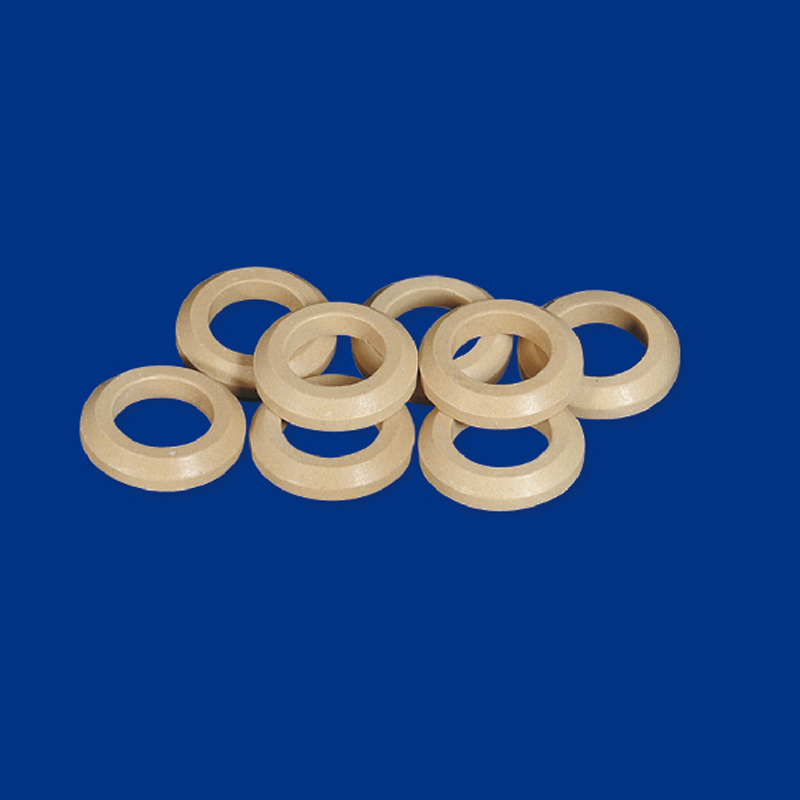



Gansu Juxiang Fluoroplastics Technology Co.,Ltd. is a fluoroplastic manufacturer formed as a joint venture between Zhejiang Jiaxiang Fluoroplastics Co., Ltd. and Gansu Juhua New Materials Co., Ltd. of the Juhua Group, with production bases in Zhejiang and Gansu. Our Filled PTFE Product manufacturer range covers PHBA (Ekonol) filled PTFE compound supplied as rod, tube, sheet and moulded blank, and as finished machined components to drawing.
Filling changes what PTFE can carry. Unfilled PTFE is chemically inert and low friction, but it cold-flows under sustained load and wears quickly when run dry. A PHBA-filled grade keeps the chemical resistance and the low-friction surface while adding hardness, creep resistance and dimensional stability at temperature. That is what moves the material from gasket duty into bearing pads, piston rings, valve seats and sliders.
Product Range and Where Each Form Fits
The range is organised by delivered form, because the form decides the machining route, the inspection plan and the way the part is finally installed. Rod and tube go to turned rings and bushes; sheet goes to cut gaskets, pads and slider plates; moulded blanks go to large or thick-section parts where machining from stock would waste material and cut across the flow direction.
| Product form | Typical configuration | Application fit | Specification focus |
|---|---|---|---|
| Filled PTFE tube and rod | Moulded stock, turned to drawing | Bushings, bearing sleeves, guide rings, piston rings | OD/ID, wall concentricity, filler dispersion, straightness |
| Filled PTFE sheet and skived sheet | Flat sheet, cut or profiled | Flange gaskets, wear pads, slider plates, insulation washers | Thickness tolerance, flatness, density, surface finish |
| PTFE piston rings and guide rings | Split or closed rings, stepped or angle cut | Hydraulic and pneumatic cylinders, compressors, reciprocating service | Radial section, free gap, side clearance, bore finish |
| Bearing pads and sliders | Plates, curved pads, custom profiles | Oil-free bearings in water and water vapour, expansion joints, bridge sliders | Compression creep, hardness, PV limit, mating surface roughness |
| Valve seats, cocks and thrust rings | Seat rings, stem seals, ball seats | High-temperature valves, chemical and petrochemical service | Compression set, chemical exposure list, torque behaviour |
| Gaskets and packing rings | Cut, moulded or machined | Chemical pipelines, tank mouths, pump and valve sealing | Creep relaxation, bolt load retention, thickness tolerance |
PHBA Filling: Material Behaviour and Published Values
PHBA — traded as Ekonol — is a crystalline aromatic high polymer. Compounded into PTFE it raises hardness and compression creep resistance, improves friction and wear behaviour, and has no corrosive effect on metal counterfaces, which matters where the mating surface is steel or stainless steel. It suits duties where grease cannot be tolerated: high-temperature oil-free bearings, water and water-vapour operation, valve internals and structural sliders.
- Tensile strength, minimum: 13.2 MPa
- Ultimate elongation, minimum: 284 %
- Density: 1.94 g/cm³
These are the published values for the PHBA-filled grade. The working figure for a specific part is set with the filler loading and the machining route, so a bearing pad and a thin-section gasket are not specified from the same data point.
Application Fit by Duty
Oil-free bearings and bearing pads
Water, water vapour and high-temperature air are where filled PTFE earns its place over grease-lubricated bronze. The compound carries load without stick-slip and does not wash out of the bearing gap. We size the pad or sleeve around the projected pressure, sliding speed and the surface roughness of the shaft it runs against.
Valve and seat components
Seats, thrust rings and cock internals see combined thermal and chemical load. PHBA filling holds the seat geometry under bolt load and cycling, and the compound remains inert against the media list supplied with the enquiry. Where the valve is metal-seated, we confirm the counterface material before fixing the grade.
Dynamic sealing
Piston rings, guide rings and packings rely on a stable radial section and controlled free gap. Filled compound reduces wear on the rod and keeps the ring from extruding into the clearance at temperature. Ring gap, side clearance and groove dimensions are matched to the cylinder bore and the operating temperature band.
Structural and bridge sliders
Sustained load at low sliding speed is a creep problem more than a friction problem. Filled PTFE pads hold thickness under permanent load, tolerate outdoor exposure and release smoothly against stainless sliding plates without lubrication.
Critical Specifications We Work To
A filled PTFE part is defined by the duty, not by the grade name alone. The specification set we build a proposal around normally includes:
- Filler type and loading, with the grade identified on the drawing or the material sheet
- Density, tensile strength and elongation at the agreed test method
- Hardness and compression creep under the stated load, temperature and time
- Friction coefficient and permissible PV at the actual sliding speed
- Coefficient of thermal expansion where the clearance closes at temperature
- Dimensional tolerance, concentricity, flatness and surface finish
- Ring free gap, radial section and groove fit for sealing parts
- Media exposure list, concentration and continuous operating temperature
- Mating surface material and roughness for wear-critical parts
Configuration, Machining and Quality Control
Formulation design, mould optimisation and process analysis are handled in-house, and production parameters are monitored through the run rather than checked only at the end. Machining is carried out on the same site as compounding, which keeps the link between the batch and the finished part traceable. Where a part is stress-sensitive in thin section, the machining sequence and any stress relief step are agreed before the first article.
Dual-base scheduling across Zhejiang and Gansu lets us place repeat volumes and development batches without competing for the same press time. First articles are submitted for dimensional and material approval before series production, and the inspection scope for series parts is fixed at that point.
Information We Use to Configure Your Solution
Drawings or samples are the starting point, but the configuration is settled by the working conditions. The following inputs let us return a grade, a machining route and a price without a second round of questions:
- Part drawing with tolerances, or a sample with the critical dimensions marked
- Function of the part and the motion it sees — static, rotating, reciprocating, oscillating
- Load, sliding speed, duty cycle and expected service life
- Continuous and peak temperature, including start-up and cleaning cycles
- Media in contact, concentration, and whether steam or water vapour is present
- Mating surface material, hardness and roughness
- Annual quantity, batch size and delivery pattern
- Inspection scope, test reports and documentation required at delivery
- Packaging, labelling and any cleanroom or handling requirement
Documentation, Packaging and Delivery Scope
Shipments carry the agreed inspection records, material identification and handling guidance for the grade supplied. Parts are packed to protect machined faces and ring gaps in transit, with labelling matched to the customer's part number where required. For the related PHBA grade used in higher-load bearing and slider work, see PHBA filled PTFE product.
Questions We Answer Before a Project Starts
Can you machine filled PTFE parts to our drawing rather than supply stock shapes only?
Yes. Custom manufacturing to drawings or samples is our core service. We supply rod, tube, sheet and moulded blank as stock forms, and finished components — bearing pads, piston rings, guide rings, seats, thrust rings, gaskets and sliders — machined to the tolerances on your drawing.
How do we choose between PHBA-filled and other filled PTFE grades?
The choice follows the duty. PHBA filling is used where creep resistance, hardness and metal-safe running matter at temperature, particularly in water and water vapour. Where the requirement is mainly dimensional stability in a gasket, or electrical or thermal behaviour, a different compound or a modified PTFE sheet is the better fit, and we say so before quoting.
What tolerance and finish can be held on a machined filled PTFE ring?
Tolerance and finish are agreed per feature, because a thin ring and a thick bearing pad behave differently after machining. We confirm the achievable band on the drawing, produce a first article for approval, and hold that band through series production with the inspection scope fixed at approval.
What do you need to quote a filled PTFE component?
A drawing or sample, the load and sliding speed, the temperature band, the media list, the mating surface, the annual quantity and the inspection and documentation scope. With those we return a grade recommendation, a machining route and a price, and we reply to enquiries within 12 working hours.